THE POLITICS OF CONSISTENCY | Analytical Series
 The Politics of Consistency:
A Comparative Analysis of the FIFA World Cup 2026 and Qatar 2022
Sport, Sovereignty, and Selective Scrutiny in the Arena of Global Governance
“This paper undertakes a comparative analysis of the international community’s response to two consecutive FIFA World Cup host nations — Qatar (2022) and the United States, Canada, and Mexico (2026) — with particular attention to the asymmetric application of human rights scrutiny. Drawing on documented incidents of immigration-related exclusion, detailed examination of Western media coverage decisions — with the BBC as a primary institutional case study — and the institutional responses of FIFA, the paper argues that international criticism of World Cup hosts is not governed by universal principle but by geopolitical power, cultural hierarchy, and media ecosystem biases rooted in postcolonial structures. The analysis demonstrates that standards applied to Qatar 2022 with singular intensity have been applied to North America 2026 with conspicuous restraint, notwithstanding equivalent or graver documented violations of the openness and inclusivity that FIFA publicly mandates. The paper contributes to the literature on global sports governance, postcolonial international relations, and the geopolitics of norm application.”__ Prof. Habib Badawi
PREFACE: BEYOND THE PITCH — THE WORLD CUP AS A MIRROR OF INTERNATIONAL STANDARDS
The FIFA World Cup has long ceased to be a mere celebration of athletic prowess. In the contemporary era, it evolved into a global amphitheatre where the intricate and often contentious domains of politics, diplomacy, national image-making, and human rights advocacy converge with unprecedented intensity. While the drama of the tournament unfolds on the verdant pitches that temporarily capture the world’s attention, the host nation finds itself under international scrutiny that extends far beyond goals, possessions, and tactical innovation. To host the World Cup is to invite the world not only to a festival of football but also to a comprehensive audit of governance, social policy, and moral legitimacy.
Comparing the FIFA World Cup 2026, co-hosted by the United States, Canada, and Mexico, with the previous edition in Qatar 2022 offers fertile ground for inquiry. This is more than an academic comparison of two events held four years and thousands of miles apart. It is an occasion to examine whether standards for host nations are genuinely universal — whether the international community of states, media organisations, and human rights bodies employs a single, consistent measure, or whether the geography of criticism is determined by geopolitical power, strategic alliances, and culturally mediated perceptions of the ‘other.’
This analysis examines why similar human rights concerns at the Qatar 2022 and North America 2026 World Cups have prompted starkly different international reactions. The focus is not on the validity of those criticisms but on the geography of outrage and the architecture of double standards.
I. THE SPECTER OF QATAR 2022: A TOURNAMENT TRIED IN THE COURT OF GLOBAL OPINION
Prior to the opening fixture in Qatar, a chorus of condemnation dominated global discourse. International media outlets, Western governments, and advocacy groups launched an unprecedented campaign against the host nation. Migrant labour conditions on the newly constructed infrastructure projects became the subject of relentless investigations and moral editorials. The country’s legal framework regarding LGBTQ+ rights and women’s freedoms was dissected and deplored across the Western press. There were concerted calls for boycotts, and protests from European teams — most symbolically, the German national team’s gesture of covering their mouths during a team photograph — became iconic images of the tournament’s prelude. The 2022 World Cup was framed not as a sporting event but as a moral test that Qatar, in the eyes of its critics, was destined to fail.
This intense scrutiny functioned as political theatre, in which the act of hosting was presented as a transgression. The underlying narrative was clear: an Arab, Muslim-majority nation was, by its very nature, unfit to steward a global festival of unity and diversity. The criticisms, while not without factual basis regarding certain labour reforms still in progress, were often devoid of historical context regarding the pace of development, or of the selective amnesia applied to similar or worse conditions in previous host nations. Entire journalistic subgenres, as noted by Associate Professor Andreas Krieg of King’s College London, were essentially invented for the purpose of ‘Qatar bashing.’¹ The nation was held to an exacting, sometimes impossible, standard — one that seemed to demand the overnight transformation of deeply embedded social and economic structures.
Yet, despite this torrent of pre-tournament condemnation, Qatar 2022 concluded not in ignominy but in widespread, if sometimes grudging, acclaim. When the matches began, the sporting spectacle proved transcendent. The infrastructure — from the cutting-edge, air-conditioned stadiums to the newly laid metro system — functioned with a logistical efficiency that drew praise from even the most cynical travelling fans and journalists. The compact nature of the tournament, enabling supporters to attend multiple matches in a single day, was hailed as a model for future editions. Security was robust yet unobtrusive; Doha was lauded for its hospitality, safety, and organisational prowess. Many of the same voices that had predicted chaos were compelled to acknowledge that Qatar had delivered a tournament of the highest calibre.
The legacy of Qatar 2022 is therefore paradoxical: it was simultaneously the most criticised World Cup before its commencement and one of the most operationally successful editions in the tournament’s history. This experience demonstrated, with considerable force, that pre-tournament moral outrage does not necessarily determine a tournament’s ultimate historical assessment.
II. THE 2026 CRUCIBLE: IMMIGRATION, EXCLUSION, AND THE AMERICAN PARADOX
Four years later, as the 2026 World Cup opened with a vibrant Mexico versus South Africa fixture, the controversies that had defined Qatar’s tenure as host seemed to shadow the North American edition. Yet the nature of the concerns had shifted, producing a new and equally troubling set of issues. The questions now dominating discourse centre on the immigration and border enforcement policies of the United States, which is hosting the majority of the 48-team tournament — the largest in World Cup history. Human rights organisations, including Amnesty International, issued stark warnings. In its report titled Humanity Must Triumph, Amnesty cautioned that the 2026 World Cup risked becoming a platform for human rights violations rather than an inclusive global celebration, pointing to the dangers faced by millions of fans, players, and journalists from US immigration, detention, and deportation policies.² The report argued that restrictions on freedom of expression and assembly directly threaten the ‘safe and inclusive’ tournament promised by FIFA.
This criticism was not an isolated sentiment. A coalition of global human rights bodies called upon FIFA to leverage its influence to ensure that the host nations — particularly the United States — respect the rights of all participants. They stressed that the prestige of hosting a global sporting event does not exempt a host from its international human rights obligations. The inherent tension was glaring: a nation that prides itself on being a ‘nation of immigrants’ had implemented an entry regime that, by its very enforcement mechanisms, excludes, detains, and deports with an efficiency that rivals the logistical mastery it brings to stadium management.
The Case of Omar Abdulkadir Artan
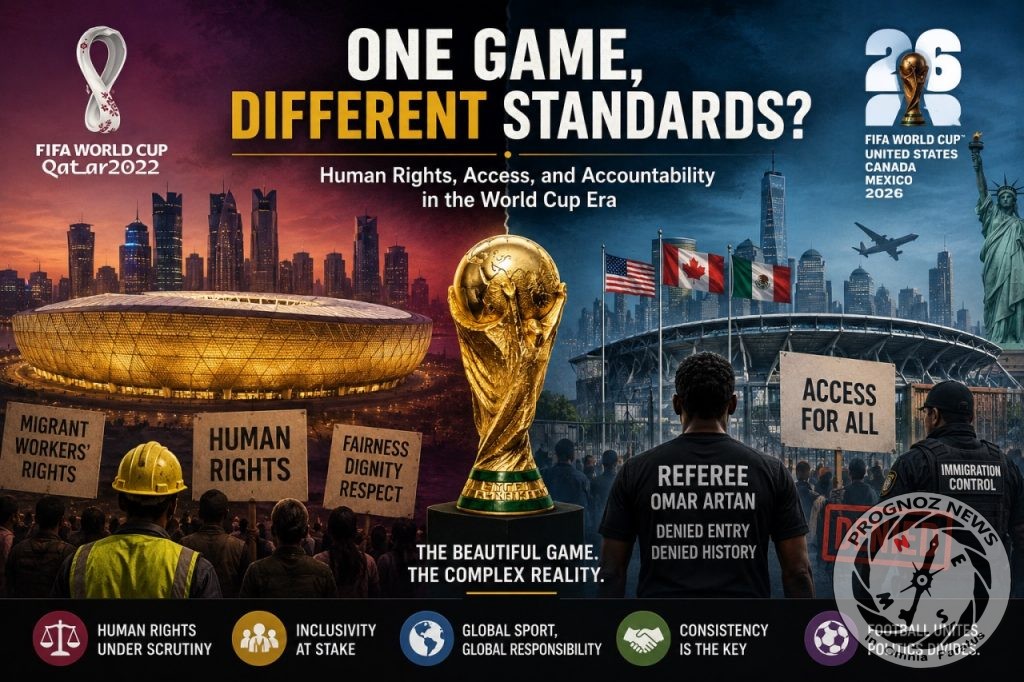
Perhaps no single incident crystallised the contradictions of the 2026 World Cup more sharply than the exclusion of Somali referee Omar Abdulkadir Artan. Although he held a valid visa and a FIFA appointment, Artan was refused entry into the United States and subsequently removed from the tournament’s referee roster, thereby forfeiting his chance to become the first Somali official in World Cup history. US authorities cited undisclosed security concerns, while sections of the media — without proof — alleged ties to criminal suspects.³ The football world responded with near-universal consternation: the Confederation of African Football, which had named Artan its Referee of the Year for 2025, condemned the decision, and UEFA’s subsequent appointment of him to the high-profile European Super Cup was widely interpreted as a direct institutional rebuke to Washington.⁴ His exclusion became a cause célèbre that laid bare how the border enforcement prerogatives of a host nation can override the very ethos of global sporting openness that FIFA is mandated to uphold.
A Pattern of Exclusion
The Artan case was not an isolated occurrence. At least fifteen Iranian officials and staff members were denied visas ahead of their national team’s participation. Iraqi striker Aymen Hussein was subjected to a seven-hour interrogation at Chicago’s O’Hare Airport before being grudgingly admitted to the country.⁵ Team photographer Talal Salah was detained for over ten hours, his personal device searched, before being expelled. Thousands of fans from across the world faced restrictions, denials, and prohibitive costs — a stark departure from previous World Cups, where host governments typically eased immigration requirements to facilitate global attendance.
England football legend Ian Wright articulated the growing sense of incredulity in a widely circulated video statement: ‘Every few hours it’s another story about fans denied, players denied, officials denied, journalists denied… The most expensive tickets ever, expensive accommodation, and transport through the roof. Is this how the hosts behave, really?… Why are we not hearing more? Are we seeing how Qatar got dragged?’⁶ Wright’s question encapsulates the central enigma of the 2026 tournament: where is the global outcry equivalent to that which engulfed Qatar in 2022?
III. THE BBC AND WESTERN MEDIA: THE ARCHITECTURE OF SELECTIVE OUTRAGE
Perhaps the most revealing illustration of the double standard at play comes from the media itself — and specifically from the British Broadcasting Corporation (BBC), an institution with a global mandate and a powerful influence on international discourse. The BBC’s coverage plans for the two tournaments provide a case study in selective scrutiny.
During the 2022 World Cup in Qatar, the BBC made a conspicuous and deliberate decision: it did notbroadcast the opening ceremony. Instead, viewers were presented with a studio discussion in which presenter Gary Lineker and pundits Alex Scott and Alan Shearer condemned Qatar on multiple fronts — migrant worker abuses, discrimination against LGBTQ+ individuals, women’s rights, and the integrity of the bidding process. The message was unambiguous: Qatar’s transgressions were so profound that the celebration of the tournament’s commencement was unwarranted.
Contrast this with the BBC’s approach to the 2026 World Cup in the United States. Despite the documented human rights concerns — the immigration crackdown leading to deaths including those of Renee Good and Alex Pretti; the exclusion of a FIFA-appointed referee; the detention of accredited journalists and players; and broader regional instability arising from US and Israeli military operations, including strikes on Iranian territory, which have significantly heightened tensions across the Middle East — the BBC announced it would broadcast the opening ceremonies across the United States, Canada, and Mexico as normal. A BBC spokesperson stated that coverage would ‘address issues,’ but the institutional decision to broadcast the ceremony itself, rather than replace it with a condemnatory panel, speaks volumes.
To fully appreciate the inconsistency, one must revisit BBC coverage of the 2018 World Cup in Russia. Despite widespread concerns about human rights abuses, the Kremlin’s role in the Syrian conflict, and systematic attacks on civilian infrastructure, the BBC broadcast the opening ceremony without analogous preemptive condemnation. The pattern is disconcertingly clear: a European host (Russia, despite its adversarial geopolitical posture) and a close Western ally (the United States) are afforded a presumption of legitimacy, or at least a measurably muted tone of criticism. A non-Western, Arab, Muslim host — Qatar — is subjected to a qualitatively different, far more aggressive, and performative standard of outrage.
As Associate Professor Krieg observed on social media platform X: ‘An entire new journalistic trade of “Qatar bashing” was invented… Issues over accessibility, human rights, affordability, and security over this World Cup in the US/Mexico/Canada are much worse. Where are all the op-eds?’⁷ The silence, or relative restraint, from the same quarters that once thundered against Doha is not an accident. It is a structural feature of a global media ecosystem still deeply influenced by geopolitical hierarchies and postcolonial cultural biases.
This divergence is not merely a matter of journalistic ethics; it carries profound political consequences. The framing of a host nation as either ‘deserving’ of scrutiny or effectively ‘above’ shapes public perception, influences diplomatic relations, and impacts the commercial and reputational value of the tournament itself. The implication embedded in Western media’s differential treatment is clear: that the human rights of migrant workers in Qatar are inherently more newsworthy than the treatment of fans, players, and accredited officials at the borders of the United States; that discrimination against LGBTQ+ individuals is a unique sin of the Arab world, while comparable or related restrictions elsewhere are background noise. This is not objective journalism. It is the expression of a postcolonial hierarchy of moral concern — one in which the power to determine which suffering is visible has become an instrument of geopolitical reproduction.
IV. FIFA, SOVEREIGNTY, AND THE LIMITS OF SPORTING NEUTRALITY
At the institutional centre of this crisis sits FIFA, the global governing body of football. President Gianni Infantino has found himself navigating a treacherous course between the traditional principle of host country sovereignty and the growing, insistent demands for human rights accountability. During the Qatar 2022 cycle, Infantino famously defended the tournament against what he termed ‘hypocrisy,’ delivering a passionate statement on the dignity of migrant workers and pointing out that many had earned livelihoods and developed skills that would benefit their home countries. For this, he was pilloried in the Western press.
Facing the 2026 crisis, Infantino’s stance has been one of cautious deference to state authority. Responding to questions about the exclusion of Omar Artan and the broader pattern of immigration restrictions, he called on critics to ‘calm down,’ reiterating that FIFA possesses neither the legal nor the practical authority to override the migration decisions of sovereign nations such as the United States. While this position is consistent with international law and the standard operating procedures of major sporting bodies, it has drawn sharp criticism from those who argue that FIFA’s economic leverage and moral platform demand a more interventionist posture. Critics contend that by accepting hosting bids from nations with known restrictive policies, FIFA implicitly endorses those policies and bears a corresponding responsibility to negotiate enforceable guarantees of access and non-discrimination.
The Artan case became a defining test of institutional integrity. Here was an official — a neutral, highly qualified referee appointed by FIFA itself — prevented from fulfilling his duties by the unilateral action of the host government. FIFA’s response, while legally defensible, was institutionally feeble. To declare the matter ‘out of its hands’ is to abdicate the responsibility that comes with orchestrating a global event. The organisation’s reluctance to confront the United States with the same energy it might have directed at a less powerful host nation reveals the inherent power asymmetries within global sports governance. FIFA’s evident caution about a direct confrontation with Washington — contrasted sharply with its more assertive posture toward smaller, less geopolitically significant hosts — reinforces the central argument of this analysis: that the application of international standards is not merely a matter of principle but a function of power.
V. THE GEOPOLITICS OF SCRUTINY: POWER, PRESTIGE, AND THE WEIGHT OF CRITICISM
To understand why the United States has not faced the same degree of international pressure as Qatar, one must move beyond the specificities of policy and examine the broader geopolitical landscape. Qatar, despite its immense wealth and considerable strategic importance in the Gulf, is a small peninsula state without the cultural, military, or media hegemony that the United States projects globally. Criticising Qatar is, from the perspective of Western governments and media organisations, a low-risk, high-reward strategy: it carries no credible threat of diplomatic retaliation, economic sanction, or visa denial for the critics themselves. It permits the performance of moral virtue without any tangible cost. In the prevailing international cultural imaginary, the nation represents a permissible ‘other’ against which Western normative values can be favourably contrasted.
The United States, by contrast, possesses immense structural power. It is the gravitational centre of global media, the issuer of the world’s primary reserve currency, and an unrivalled military superpower. Openly and persistently criticising US immigration enforcement — particularly during a domestic political cycle sensitive to such framing — carries genuine institutional risks. Media organisations are reluctant to antagonist a government that controls access to its officials, operates within the same cultural ecosystem, and possesses numerous mechanisms of subtle retaliation: denial of press credentials, heightened scrutiny of foreign correspondents, or the withdrawal of political goodwill. Furthermore, the United States deploys a sophisticated public relations apparatus adept at framing its policies within narratives of national security, public safety, and the rule of law. Critics are readily dismissed as naïve about counter-terrorism realities or as motivated by anti-Americanism. The same charitable interpretive framework was rarely, if ever, extended to Qatar.
This geopolitical reality is not a conspiracy; it is the unremarkable functioning of a world order in which power shapes perception. The global uproar over Qatar’s labour laws was deafening because Qatar was seen as a nation that could be lectured. The relative murmur over US immigration detention is quieter because the United States is a nation that does the lecturing. This asymmetry is, precisely, the point. If the international community genuinely upholds universal human rights standards, those standards must apply universally. They cannot be deployed as a cudgel against geopolitical rivals or convenient targets while remaining sheathed when the subject is a powerful ally. The perception — grounded in overwhelming observable evidence — that the West operates with a structural double standard is not a conspiracy theory of the Global South. It is a diagnosis of a systemic bias that corrodes the very concept of international norms.
VI. COMPARATIVE CLOSURE: THE UNRESOLVED QUESTION OF A SINGLE STANDARD
As the 2026 FIFA World Cup unfolds across the sprawling geography of North America, the debates it has generated are not merely echoes of 2022; they are a continuation of the same fundamental struggle over the meaning and application of international legitimacy. The tournament has become a stage upon which competing visions of governance, identity, and global influence are projected. The question is no longer whether the World Cup is political — it manifestly is — but rather whose politics will prevail and by what measure.
The comparison reveals that the controversies surrounding Qatar and the United States are not identical, and to insist otherwise would be intellectually dishonest. The specific human rights challenges of a rapidly developing Gulf state differ structurally from those of an established Western superpower. Yet the principles at stake — the right to non-discriminatory access, the humane treatment of workers and visitors, the freedom of movement for accredited participants, and the obligation of a host to provide a safe and inclusive environment — are universal. The critical and unresolved question is whether these principles are being applied with genuine consistency. The evidence presented here strongly suggests they are not.
The contrasting media responses themselves are damning. The BBC’s decision to broadcast the US opening ceremony while replacing Qatar’s with a condemnation panel is not an isolated editorial choice; it is a declaration of differentiated moral value. The relative silence of Western political leaders who were so voluble about Qatar’s conduct speaks to a diplomatic convenience that borders on complicity. The exclusion of Omar Artan — a distinguished African referee awarded the continent’s highest honour in his field — should have triggered an international outcry comparable to, or greater than, any grievance lodged against Qatar. That it did not is a testament to the structural power of the host and the practical weakness of the principle.
At the institutional level, FIFA emerges from this comparison with its credibility diminished. By failing to enforce, or even clearly articulate, a binding set of access and human rights standards applying equally to all bidding nations and hosts — from Qatar to Russia to the United States — FIFA has ceded its moral authority to the very geopolitical currents it should strive to transcend. The organisation’s reluctance to stand firmly before Washington in the Artan case, even as it quietly absorbed immense pressure on Doha, suggests that its commitment to ‘inclusivity and equal opportunities for all associations’ is conditional — contingent upon the political and economic weight of the nation in question.
Ultimately, the long-term legacy of these two consecutive World Cups will be shaped not only by the football played but by the answer to a single, persistent question: does the global community possess a single standard of judgment for its members? If the answer is yes, then the treatment of Qatar 2022 and North America 2026 represents a profound and damaging hypocrisy that must be rectified in future tournaments and in the governance frameworks that underpin them. If the answer is no — if standards are inherently, inevitably shaped by geopolitics, media ownership, and historical prejudice — then the language of universal human rights becomes a hollow instrument of power, deployed only against the weak and silenced in the presence of the strong. The 2026 World Cup, like Qatar 2022 before it, is more than a football tournament. It is a test of whether international norms can survive the unequal distribution of global power. The evidence, for now, remains deeply troubling.
00000
🏟️ BBC skipped Qatar’s ceremony. Showed a condemnation panel instead.
🇺🇸 US blocks FIFA referees & thousands of fans — BBC broadcasts normally.
Same FIFA… Different rules… The Global South is watching 👁️
NOTES
1. Krieg, A. [@andreaskreig]. (2026, June). Posts on geopolitical double standards in World Cup coverage. X (formerly Twitter).
2. Amnesty International. (2026). Humanity must triumph: Human rights risks at the 2026 FIFA World Cup. Amnesty International.
3. AP News. (2026, June 9). A Somali referee won’t officiate in the World Cup after being denied entry into the United States. Associated Press.
4. beIN SPORTS. (2026, June 11). Somali referee Omar Artan appointed to officiate UEFA Super Cup match between Paris Saint-Germain and Aston Villa.
5. The New Arab. (2026). Iraq World Cup striker Hussein questioned for hours at Chicago airport. The New Arab.
6. Wright, I. [@ianwright0]. (2026, June). Video commentary on 2026 World Cup access restrictions. TikTok / social media platforms.
7. Krieg, A. [@andreaskreig]. (2026, June). Op-ed commentary on Western media double standards. X (formerly Twitter).
REFERENCES
Amnesty International. (2026). Humanity must triumph: Human rights risks at the 2026 FIFA World Cup. Amnesty International.
Associated Press. (2026, June 9). A Somali referee won’t officiate in the World Cup after being denied entry into the United States. AP News.
beIN SPORTS. (2026, June 11). Somali referee Omar Artan appointed to officiate UEFA Super Cup match between Paris Saint-Germain and Aston Villa. beIN SPORTS.
ITV News. (2026, June 9). A Somali referee was denied entry to the US for the World Cup. ITV News.
Krieg, A. [@andreaskreig]. (2026, June). Commentary on geopolitical double standards in World Cup media coverage. X (formerly Twitter).
The New Arab. (2026). Denied US visa: Somali referee Omar Artan returns home a hero. The New Arab.
The New Arab. (2026). Iraq World Cup striker Hussein questioned for hours at Chicago airport. The New Arab.
The New Arab. (2026). Why thousands of Arab football fans may miss the 2026 World Cup. The New Arab.
Wright, I. [@ianwright0]. (2026, June). Video commentary on 2026 World Cup access restrictions. TikTok and social media platforms.



Most Readings