Ten Faces of Contemporary Tyranny
By Matthew Parish, Associate Editor
Monday 20 July 2026
The word evil is not one political scientists ordinarily employ. It is imprecise, morally charged and liable to substitute indignation for analysis. Yet there are occasions upon which excessive delicacy becomes a form of evasion. A government that imprisons people for their opinions, excludes half the population from public life, attacks neighbouring countries or treats an entire nation as the private property of one family is not merely following an alternative administrative model. It is doing evil.
Any list of the world’s ten most reprehensible dictators must nevertheless be provisional. There is no reliable moral yardstick by which one may compare a political prisoner in Belarus, a girl forbidden to attend school in Afghanistan and a Ukrainian family whose home has been destroyed by a Russian missile. Nor is every authoritarian ruler personally responsible for every crime committed beneath him. Governments are machines involving generals, policemen, judges, propagandists, informers and opportunists.
The relevant questions are therefore broader. How much power does the ruler possess? How extensively does he use violence or intimidation? How many people live beneath his authority? Does his repression extend beyond his borders? Has he inherited a cruel system or deliberately made it worse?
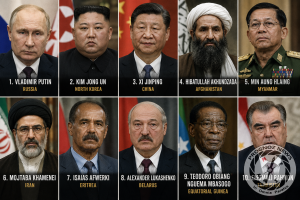
Judged by those criteria, the following ten rulers represent some of the darkest forms of contemporary government as of July 2026.
Vladimir Putin — Russia
Vladimir Putin occupies first place because he combines internal dictatorship with a war of imperial conquest. Russia is not merely an authoritarian country in which opposition candidates are excluded, journalists intimidated and civil society organisations suppressed. It is also a nuclear power engaged in the destruction and attempted subjugation of a neighbouring European state.
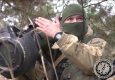
By July 2026, Russia’s full-scale war against Ukraine has continued for more than four years. Russian forces still occupy approximately one fifth of Ukrainian territory. The war has involved attacks upon civilian infrastructure, the destruction of towns and cities, forced displacement and extensive allegations of torture, unlawful detention and the deportation or indoctrination of Ukrainian children. International investigators have also continued documenting alleged mistreatment and execution of prisoners of war.
At home, the same logic prevails in less spectacular form. Political criticism is increasingly treated as extremism. The memory of Alexei Navalny is itself dangerous enough that displaying his image may bring prosecution. Independent thought has become a suspected act of treason.
Putin’s particular wickedness lies in the marriage of personal power with historical fantasy. He has persuaded himself that Russia has rights over neighbouring peoples because they once belonged to an empire governed from Moscow. The result is a dictatorship that does not merely imprison its own citizens. It exports death.
Russia in 2026 is widely characterised as a personalised autocracy in which Putin and his immediate circle make strategic decisions without meaningful judicial or legislative accountability.
Kim Jong Un — North Korea
North Korea remains the most complete totalitarian state in existence. Other dictatorships allow fragments of private life, limited commerce or carefully controlled contact with the outside world. North Korea attempts to regulate reality itself.
Kim Jong Un presides over a hereditary political religion in which the ruling family is treated as the embodiment of the nation. Information is rationed, movement restricted and dissent rendered almost inconceivable by surveillance, punishment and fear. Political loyalty is not merely an individual obligation but a family inheritance. The alleged wrongdoing of one person may damage the prospects of relatives and descendants.
The country’s isolation makes precise information difficult to verify. That opacity is part of the system. A government that prevents outsiders from seeing its prisons and citizens from seeing the outside world creates an environment in which abuse can proceed without ordinary restraint.
Meanwhile the regime devotes immense resources to missiles, nuclear weapons and military prestige despite recurring hardship among the population. North Korea’s tragedy is not only that it is poor. It is that its poverty is maintained by a ruling system that considers control more important than human flourishing.
Kim remained firmly in power in July 2026, appearing with Xi Jinping during the Chinese leader’s June visit to Pyongyang and reiterating the strength of their alliance.
Xi Jinping — China
Xi Jinping rules more people than any other dictator. This fact alone gives his decisions an extraordinary moral weight. China is not governed by one man in precisely the same manner as North Korea, yet Xi has concentrated authority to an extent unseen in the country since the era of Mao Zedong.
The Chinese Communist Party controls the executive, legislature and judiciary. Independent national political competition does not exist. Under Xi, ideological conformity and personal loyalty have intensified, as has the technological capacity of the state to monitor communications, movement and association.
The gravest allegations concern Xinjiang, where Uyghurs and other predominantly Muslim communities have faced mass detention, coercive assimilation, forced labour allegations and severe restrictions upon religion and culture. Tibet remains subject to intense controls while Hong Kong’s former political liberties have been subordinated to a sweeping national security system.
China’s dictatorship is especially important because it presents itself as a model of modernity. Its trains run, its cities glitter and its companies produce sophisticated technologies. This can create the illusion that repression is merely the price of efficiency.
Yet efficiency without liberty can become the efficient organisation of fear. China demonstrates that tyranny need not appear shabby or economically stagnant. It may arrive with facial recognition, high-speed railways and an application on every telephone.
Human Rights Watch reported in February 2026 that repression under Xi had deepened both within China and abroad, with especially severe pressure upon Uyghurs, Tibetans, unofficial religious communities and Hong Kong.
Hibatullah Akhundzada — Afghanistan
The Taliban’s supreme leader, Hibatullah Akhundzada, governs through a combination of religious absolutism and institutional secrecy. He rarely appears in public, yet his decrees shape almost every aspect of Afghan life.
Under Taliban rule, women and girls have been progressively excluded from secondary and higher education, many forms of employment and much of public life. This is not an incidental defect of the regime. It is one of its central purposes. Half the population is being denied the ordinary means by which human beings develop their abilities and participate in society.
Akhundzada’s government also suppresses political dissent, restricts the press and has expanded the use of severe corporal and capital punishments. The United Nations has described the Taliban’s treatment of women as resembling gender apartheid — a system in which discrimination is not sporadic but constitutes the organising principle of the state.
There were rumours early in 2026 that Akhundzada had been killed during Pakistani attacks. These reports were not confirmed. Subsequent statements and a May 2026 sermon were attributed to him and the International Criminal Court continued to identify him as the Taliban’s supreme leader and a de facto Afghan authority.
Akhundzada’s evil is austere rather than flamboyant. He does not require monuments on every street. His ambition is more intrusive: to determine how millions of people may dress, study, work, speak and think.
Min Aung Hlaing — Myanmar
Min Aung Hlaing seized power in Myanmar’s February 2021 military coup, extinguishing a limited democratic experiment and plunging the country into civil war. In April 2026, he exchanged his military title for the presidency after an election organised beneath military domination and widely dismissed as a sham.
The change was constitutional theatre. Min Aung Hlaing did not surrender power. He rearranged its furniture.
Myanmar’s armed forces have been accused of indiscriminate air attacks, village burnings, arbitrary detention, torture and executions. The military had already played the central role in the campaign against the Rohingya, hundreds of thousands of whom fled into Bangladesh. Since the coup, violence has spread across the country as resistance forces and ethnic armed organisations challenge military rule.
The Burmese dictatorship illustrates an old truth: uniforms do not make government orderly. The generals justified their intervention as necessary to preserve national unity. Instead they shattered what unity remained.
Min Aung Hlaing’s elevation to the presidency in April 2026 preserved the military system beneath a civilian-looking title. His loyalist Ye Win Oo succeeded him as commander-in-chief while the former general retained ultimate political authority.
Mojtaba Khamenei — Iran
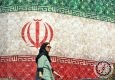
This list requires one of its most significant July 2026 corrections. Ali Khamenei, Iran’s supreme leader from 1989, was killed on 28 February 2026. He has been succeeded by his son Mojtaba Khamenei, thereby transforming a supposedly revolutionary republic into something approaching an hereditary clerical dynasty.
Mojtaba inherited a system in which elected institutions exist but remain subordinate to unelected religious and security authorities. The Islamic Revolutionary Guard Corps possesses enormous military, political and economic influence. Journalists, women’s-rights campaigners, labour activists, lawyers, religious minorities and political opponents have long faced detention and intimidation.
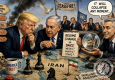
The younger Khamenei also inherited — and continued — Iran’s confrontational regional policies. By July 2026, renewed warfare involving Iran and the United States had included Iranian missile and drone attacks against regional targets and further American strikes upon Iranian military facilities.
It is too early to assess Mojtaba Khamenei’s rule with the same historical certainty applied to longer-serving dictators. Yet he entered office not as a reformer dismantling an oppressive system but as its dynastic beneficiary and defender. His position on this list rests upon the machinery he controls, the repression undertaken in its name and his willingness to perpetuate it.
Reuters identified Mojtaba Khamenei as Iran’s supreme leader in July 2026, while contemporary reporting described the succession following Ali Khamenei’s assassination.
Isaias Afwerki — Eritrea
Isaias Afwerki has ruled Eritrea since independence in 1993. No meaningful national election has removed or seriously challenged him. Independent political organisation is virtually absent and the country has long operated under an atmosphere of surveillance, militarisation and indefinite obligation to the state.
Eritrea’s national-service system has frequently required citizens to serve for uncertain periods under harsh conditions. Political and religious freedoms remain severely restricted. The absence of independent media and effective legal safeguards makes arbitrary detention particularly dangerous because prisoners may disappear from public view.
Eritrea is sometimes neglected because it is small, strategically peripheral and difficult to enter. Yet obscurity does not lessen suffering. Indeed, isolation is one of the regime’s principal defences.
Afwerki was still actively exercising presidential power in July 2026, meeting Sudanese military leader Abdel Fattah al-Burhan in Asmara on 17 July after an official visit to Egypt the previous month. Contemporary assessments continued to describe Eritrea as a surveillance state under personalised rule.
Alexander Lukashenko — Belarus
Alexander Lukashenko has ruled Belarus since 1994. His regime was always authoritarian, but the disputed presidential election of 2020 marked a descent into more comprehensive repression. Large peaceful demonstrations were met with violence, mass detention and allegations of torture.
By the end of 2025, more than a thousand people remained imprisoned on politically motivated grounds. Although several hundred prisoners were later released through internationally mediated arrangements, arrests and prosecutions continued. Releases became a diplomatic currency rather than evidence that the system had changed.
Lukashenko also surrendered much of Belarus’s strategic independence to Russia.
Belarusian territory and infrastructure assisted Moscow’s war against Ukraine, making the country both a dictatorship in its own right and an accessory to a larger imperial project.
His regime has survived not because it commands affection but because it has mastered the management of fear, dependency and exhaustion. Citizens need not believe the propaganda. They need only conclude that resistance is dangerous and futile.
Lukashenko remained the de facto ruler in July 2026. Human Rights Watch reported continuing politically motivated repression, while Reuters noted that more than 950 political prisoners remained incarcerated despite recent releases.
Teodoro Obiang Nguema Mbasogo — Equatorial Guinea
Teodoro Obiang seized power in Equatorial Guinea in 1979 and remains one of the world’s longest-serving rulers. His country possesses considerable oil wealth, yet its political system has been organised around presidential power, family privilege and the suppression of meaningful opposition.
The regime’s defenders may point to elections, ministries and a constitution. These institutions do not amount to democracy where the president dominates the state, opponents cannot operate freely and the ruling family controls the commanding heights of government.
Obiang’s son, Teodoro Nguema Obiang Mangue, serves as vice-president and apparent successor. Thus a republic has acquired the characteristics of a family estate. Public office becomes inheritance while national resources become instruments for maintaining elite loyalty.
In June 2026, Equatorial Guinea’s entire cabinet resigned after the government reportedly achieved only a small fraction of its objectives. Yet this administrative drama did not alter the true distribution of power. The president remained dominant and was expected simply to appoint another government.
Obiang’s evil is the evil of confiscation: the conversion of a country, its wealth and its future into the possessions of a ruling household.
Emomali Rahmon — Tajikistan
Emomali Rahmon has led Tajikistan since 1992 and served as president since 1994. Over more than three decades, political competition has been hollowed out, opposition movements suppressed and public institutions subordinated to presidential authority.
Rahmon has cultivated the official title “Leader of the Nation”, a phrase that reveals the personalised nature of the system. State stability is presented as inseparable from the ruler’s continued tenure. Elections occur, but the possibility of changing the government through them has become remote.
Tajikistan does not produce the international alarm associated with Russia, Iran or North Korea. Its repression is quieter. Journalists, religious figures and political opponents may be prosecuted far from the attention of the world’s major newspapers. Yet low visibility is not political innocence.
Rahmon’s longevity also raises the question of succession. His son Rustam Emomali has accumulated prominent offices and is widely regarded as a potential heir. Central Asian authoritarianism often speaks the language of republican legality while drifting towards dynastic government.
Rahmon remained firmly in office in July 2026 and was scheduled to make a state visit to Mongolia from 20 to 22 July.
The Dictators Who Left the List
Three names in the earlier version no longer belong upon a list of contemporary rulers.
Bashar al-Assad’s Syrian dictatorship collapsed in December 2024. Syria was being governed in July 2026 by transitional president Ahmed al-Sharaa. Whether the new Syrian order will develop into a pluralist state, another authoritarian system or something between the two remains uncertain. Al-Sharaa’s past and the conduct of the transitional authorities deserve close scrutiny, but Assad is no longer the ruler of Syria.
Ali Khamenei was killed on 28 February 2026 and was succeeded by Mojtaba Khamenei. The nature of the Iranian system survived the death of its previous supreme leader.
Nicolás Maduro was captured by United States forces on 3 January 2026 and removed from power. Venezuela was subsequently governed on an interim basis by Delcy Rodríguez. Her administration may warrant severe criticism and Venezuela’s future remains uncertain, but Maduro can no longer accurately be described as a contemporary dictator in office.
The Architecture of Evil
The rulers on this list are not identical. Putin is an imperial aggressor. Kim presides over hereditary totalitarianism. Xi commands a technologically advanced one-party state. Akhundzada imposes theocratic exclusion. Min Aung Hlaing represents military domination. Obiang and Rahmon exemplify personal and increasingly dynastic government.
Their similarities are nevertheless more important than their differences.
Each weakens the distinction between the state and the ruler. Each treats criticism as disloyalty. Each prefers obedient mediocrity to independent competence. Each distorts law until it protects authority rather than citizens. Each constructs a fictional unanimity in which the people perpetually endorse decisions they were never permitted freely to debate.
Modern dictatorships rarely abolish every institution. They preserve parliaments, courts, elections and constitutions because imitation legitimacy is useful. The ballot paper remains but the choice disappears. The judge remains but independence disappears. The newspaper remains but journalism disappears.
Technology has strengthened this process. Earlier dictators needed files, informers and secret policemen. Their successors possess databases, cameras, intercepted messages, biometric records and algorithms capable of identifying patterns of association. The electronic state can know where a citizen goes, whom he meets and what she reads.
Yet dictatorship retains a fundamental weakness. Because criticism becomes dangerous, bad news ceases to travel upwards. Officials lie to superiors, generals exaggerate success and economists conceal failure. The ruler gradually becomes the prisoner of the system he constructed. He sees the country through reports prepared by people terrified of displeasing him.
This is one reason dictators make catastrophic mistakes. Putin invaded Ukraine expecting submission. Military rulers in Myanmar imagined that a coup would restore order. The Iranian leadership repeatedly confused regional intimidation with strategic security. Repression can compel silence, but silence is not consent and fear is not competence.
The opposite of dictatorship is not perfection. Democracies are frequently foolish, corrupt, divided and unjust. Their merit lies elsewhere: they possess mechanisms for peaceful correction. Governments can be dismissed, newspapers can expose wrongdoing, courts can restrain ministers and opposition parties can warn of errors before those errors become national disasters.
A dictator regards these mechanisms as weaknesses. In reality they are the immune system of public life.
The ten rulers described here differ in the number of their victims and the reach of their ambitions. What unites them is a conviction that the state belongs to them and that other human beings may be confined, silenced, impoverished or killed to preserve that belief.
That is why the language of evil, used carefully, remains appropriate. Evil in politics seldom arrives announcing itself as evil. It calls itself stability, sovereignty, tradition, security, revolution or national renewal. Only later, when the prisons are full and the graves have multiplied, is the vocabulary corrected.
69 Views


Most Readings