How Long Would It Take Ukraine to Build Patriot Missiles?
By Matthew Parish, Associate Editor
Friday 31 July 2026
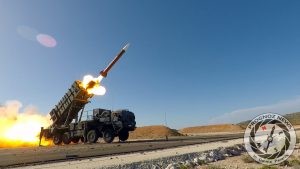
One of the most consequential strategic developments of recent months has been the prospect that Ukraine may be permitted to manufacture Patriot interceptor missiles under licence from the United States. Following President Volodymyr Zelenskyy’s meetings in Washington this week, the prospect of licensed production has become a subject of intense discussion, although public reporting has been mixed, with some reports describing President Donald Trump as supportive while others indicate that a final decision remains under consideration.
Whatever the precise state of the negotiations, the strategic question is irresistible. If Ukraine were granted the licence in three weeks’ time, how long would it actually take before the first Ukrainian-built Patriot interceptor emerged from the production line?
The answer is considerably longer than most headlines might suggest.
The Patriot missile is not a single piece of military equipment assembled from standard industrial components. It is among the most sophisticated defensive weapons ever mass-produced. Modern Patriot interceptors contain advanced radar seekers, inertial navigation systems, precision control actuators, rocket motors manufactured to extraordinarily demanding tolerances, sophisticated software and highly specialised electronic components designed to survive enormous mechanical stresses during launch and flight.
Building one resembles less the manufacture of an artillery shell than the construction of a spacecraft.
Fortunately for Ukraine, however, she would not be starting from nothing.
Over three and a half years of full-scale war Ukraine has transformed herself into one of the world’s fastest-growing defence industries. Companies that scarcely existed in 2022 are now producing long-range drones, cruise missiles, electronic warfare equipment, radar systems, optical sensors and precision guidance technologies in significant quantities. Ukrainian engineers have repeatedly demonstrated an ability to compress development cycles that would traditionally require many years into periods measured in months.
Yet Patriot production introduces entirely different challenges.
The critical obstacle is not engineering talent. Ukraine possesses an abundance of engineers. Nor is it political will. Few countries have greater motivation.
The difficulty lies in industrial qualification.
Every component supplier would require certification. Production machinery would need installation and calibration. Clean manufacturing facilities would have to satisfy exacting standards. Quality assurance procedures would need validation. Hundreds of technicians would require training by American manufacturers. Sensitive production data would have to be transferred securely. Supply chains extending across Europe and North America would have to be synchronised.
Only once these foundations were complete could serial production begin.
How long might this take?
One useful comparison comes from entirely different aerospace industries. Modern commercial aircraft production lines typically require between two and four years to establish. New missile production facilities often require similar periods.
Ukraine, however, is unlikely to build an entirely independent Patriot industry from scratch.
A far more plausible model would resemble modern automotive manufacturing. Critical components — such as radar seekers, specialised microelectronics or rocket motor elements — might initially continue to arrive from established American manufacturers.
Ukrainian facilities would progressively assume responsibility for final assembly, integration, testing and eventually increasing proportions of component manufacture.
This approach dramatically shortens the timetable.
One can therefore construct three realistic scenarios.
The optimistic scenario assumes extensive American technical assistance, priority access to equipment, existing Ukrainian industrial capacity that can be adapted rapidly and uninterrupted construction despite Russian attack. Under these assumptions, limited assembly of imported component sets could plausibly begin within eighteen to twenty-four months.
The central estimate appears rather longer.
If production facilities must be built or substantially modified, if specialised machinery requires international procurement and if supplier qualification proceeds at normal aerospace speeds, initial production is more likely after approximately thirty to thirty-six months.
The pessimistic scenario extends further still.
Should Russian missile attacks repeatedly interrupt construction, supply chains become constrained or export-control procedures delay transfer of critical technologies, production might not reach meaningful levels for four to five years. Interestingly, Ukraine’s ambassador to Washington has herself referred publicly to a possible five-year timeline for full production capability.
This suggests a reasonable estimate.
If a licence were signed in approximately three weeks’ time, one might expect:
-
Factory preparation and technology transfer: 9–15 months.
-
Equipment installation, workforce training and qualification: 9–12 months.
-
Prototype production and testing: 6–9 months.
-
Initial low-rate production: roughly 30–36 months after licence approval.
-
Mature serial production: approximately 4–5 years after commencement.
These estimates necessarily involve uncertainty, but they correspond closely with how complex aerospace manufacturing normally develops while recognising Ukraine’s unusually capable wartime industrial mobilisation.
The most interesting question is not merely when the first missile appears.
It is what the existence of a Ukrainian Patriot production line would signify strategically.
Russia has devoted immense effort to exhausting Western missile inventories. Every Patriot interceptor launched today represents one fewer available tomorrow. Domestic Ukrainian production would gradually reverse that equation. Instead of consuming finite allied stockpiles, Ukraine would become another producer contributing to the Western air-defence industrial base.
Industrial capacity is itself a strategic weapon.
Wars of attrition are rarely decided by brilliant tactics alone. They are won by the side capable of replacing losses faster than they are incurred. During the Second World War, Allied victory ultimately depended as much upon Detroit, Pittsburgh and Coventry as upon Normandy or Stalingrad.
The same industrial logic increasingly governs the war in Ukraine.
No licence signed in August will produce missiles by Christmas. Even by next summer the results are unlikely to be visible. But if Ukraine begins manufacturing Patriot interceptors within the next three years, historians may eventually regard that decision as one of the defining moments in Europe’s long transition from emergency military assistance to enduring collective defence.
The first missile may take years to emerge. The strategic consequences could endure for generations.
4 Views



Most Readings