Pyongyang’s Arsenal Comes to Ukraine
By Matthew Parish, Associate Editor
Wednesday 12 August 2026
There was a time when the suggestion that Russia — heir to the Soviet Union, possessor of one of the world’s largest military-industrial complexes and self-proclaimed great power — might depend upon North Korea for the ammunition with which to wage a European war would have sounded like satire. It no longer does.
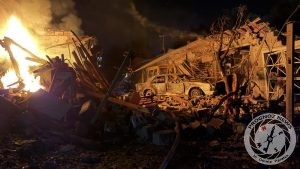
In the latest episode, Ukrainian President Volodymyr Zelenskyy has said that North Korean ballistic missiles were used in Russian attacks upon Ukraine on 11 August 2026. Ukrainian officials attributed missiles used in the deadly attack upon a steel plant in Zaporizhzhia to North Korea. Seven workers were reported killed there. The claim comes only days after Reuters reported Ukrainian intelligence assessments that a North Korean missile unit of about 90 personnel, with as many as 120 ballistic missiles and six launchers, was deploying to Russia’s Voronezh region.
The newest attribution should still be described carefully. Identification of the weapons used in an individual attack can initially depend upon Ukrainian intelligence, fragments recovered at impact sites and assessments made while a war is continuing. Yet the broader proposition — that Russia has obtained and fired North Korean ballistic missiles against Ukraine — has long since passed beyond reasonable speculation. The United States Defense Intelligence Agency has published photographic comparisons of missile debris recovered in Ukraine with North Korean weapons and concluded that Russia has indeed employed DPRK-produced short-range ballistic missiles.
This distinction matters. One need not accept every immediate Ukrainian attribution of a particular explosion to understand that an extraordinary military supply relationship has developed between Moscow and Pyongyang.
From curiosity to supply chain
The North Korean contribution began principally as an ammunition story. Russia fires artillery on a scale that peacetime European defence industries were never designed to accommodate. North Korea, by contrast, inherited an enormous Soviet-style military establishment constructed around precisely the calibres and concepts of warfare Russia uses.
The result was an almost grotesquely convenient marriage.
Pyongyang had ammunition. Moscow needed ammunition.
What began with reports of artillery transfers has evolved into something considerably more substantial. North Korea has supplied millions of artillery rounds, rockets and ballistic missiles. A 2025 report by the Multilateral Sanctions Monitoring Team said that more than 20,000 containers of North Korean munitions had been shipped to Russia from September 2023 onwards. By August 2026 Reuters was reporting assessments that North Korean supplies accounted for roughly half of Russia’s front-line munitions.
Those figures should be treated as estimates rather than an audited inventory. Wartime ammunition statistics are notoriously difficult to verify. Nevertheless the scale is unmistakable.
North Korea is no longer a marginal supplier to the Russian war effort. She has become part of Russia’s logistics architecture.
That tells us something important about Russia — although perhaps not quite what one might initially imagine.
Are Russian arsenals empty?
It would be tempting to conclude that Russia has exhausted her weapons.
That would be too simple.
Russia continues to manufacture substantial quantities of missiles, drones, artillery ammunition and other weapons domestically. Her defence industry has been placed upon a wartime footing and the Kremlin has devoted enormous financial and industrial resources to sustaining the conflict. Russian forces continue to employ domestically produced Iskander missiles alongside North Korean systems. In June 2025, for example, Ukrainian reporting identified an attack involving two Iskander-M/KN-23 ballistic missiles as part of a much larger Russian strike package.
The more revealing conclusion is therefore not that Russia has no weapons left. It is that Russia cannot comfortably generate, from her own production and accumulated stocks alone, all the ordnance required to fight the war at the intensity she desires.
There is an enormous difference between those propositions.
A state fighting an attritional war does not wait until its last artillery shell has been fired before looking for another supplier. It imports ammunition so that domestic factories can replenish reserves, so that expenditure rates can remain high and so that commanders need not choose quite so frequently between using a weapon today and retaining it for tomorrow.
North Korean ammunition consequently operates as a strategic subsidy to the Russian war economy.
Every North Korean artillery round fired in Donetsk is, in effect, a Russian artillery round that need not be manufactured or removed from a stockpile. Every North Korean ballistic missile directed at a Ukrainian target permits Russia to preserve an Iskander or another indigenous missile for some subsequent operation.
The significance of North Korean supplies lies therefore not merely in their quantity. They increase Russia’s freedom of military choice.
But do the missiles work?
Here the story becomes more interesting.
North Korean weapons have traditionally been treated in much western commentary as crude copies of Soviet designs — plentiful perhaps, but inaccurate, unreliable and technologically primitive.
There was some evidence supporting that assessment during the earlier stages of their use in Ukraine. Yet warfare has provided North Korea with something extraordinarily valuable: a gigantic live-fire testing programme.
One of the principal weapons involved is generally identified as the KN-23 family of short-range ballistic missiles. The KN-23 is a solid-fuelled, road-mobile missile superficially resembling the Russian Iskander. It can fly a quasi-ballistic trajectory and manoeuvre during flight, characteristics intended to complicate interception. Public estimates place its range at up to about 690 kilometres depending upon configuration, with a substantial conventional payload.
The crucial issue is accuracy.
In February 2025 Reuters reported, citing senior Ukrainian sources, that later North Korean missiles employed by Russia had become markedly more accurate than earlier examples. Whereas earlier weapons had sometimes missed substantially, more recent missiles were reportedly landing within approximately 50 to 100 metres of their intended targets.
If those assessments are correct, Ukraine has inadvertently become part of North Korea’s weapons-development laboratory.
That is one of the most disturbing consequences of the Russo-Ukrainian war.
A missile tested over the Sea of Japan tells its engineers whether the propulsion system works, whether the guidance system functions and approximately where the weapon lands. A missile used repeatedly in an actual war provides much richer information. Engineers can compare intended coordinates with impact points, examine performance under operational conditions and progressively correct weaknesses.
The Russians receive missiles.
The North Koreans receive data.
Both sides benefit.
Reliability is not the same thing as sophistication
There is nevertheless a danger in moving from one caricature to another. North Korean missiles should neither be dismissed as useless junk nor transformed into technological wonder-weapons.
The relevant question is whether they are good enough.
For many Russian purposes, they plainly are.
A missile does not require metre-level accuracy to threaten a large industrial complex, logistics installation or urban area. Nor does every weapon in a saturation attack need to reach its target. Modern Russian attacks frequently combine ballistic missiles, cruise missiles and large numbers of drones. The defender must detect, classify and if possible intercept several different categories of threat simultaneously.
The strategic value of another 100 ballistic missiles is consequently greater than the individual technical merits of each missile might suggest.
Quantity itself becomes a capability.
Ukraine has a finite number of sophisticated air-defence interceptors. Russia understands this perfectly. A mixed attack imposes costs and choices upon Ukrainian air defence even when some of the attacking weapons malfunction or are destroyed.
North Korean missiles therefore need not be equivalent to the best Russian systems to be militarily valuable.
They merely have to arrive in sufficient numbers and work sufficiently often.
The artillery may matter still more
Ballistic missiles attract headlines because they are spectacular. The less glamorous artillery shell may ultimately have been North Korea’s more consequential contribution.
The Russo-Ukrainian war has repeatedly demonstrated that industrial capacity remains one of the foundations of military power. Satellites, artificial intelligence, drones and precision weapons have transformed warfare but they have not abolished the requirement for extraordinary quantities of explosives and ammunition.
North Korea has spent decades preparing for a conventional war on the Korean peninsula. The result is a military economy containing enormous stocks and substantial manufacturing capacity for Soviet-derived artillery calibres.
Much of this ammunition may be old. Quality control may vary. Some stocks will inevitably have deteriorated during storage. None of that makes millions of shells strategically irrelevant.
Even mediocre ammunition becomes important when available by the trainload.
And here the relationship reveals one of the central paradoxes of the war. Russia entered Ukraine presenting herself as one of the world’s pre-eminent military powers. Four and a half years later, the sustainability of its campaign depends in significant part upon an isolated state with an economy vastly smaller than Russia’s.
That is evidence of Russian weakness.
Yet it is also evidence of Russian adaptability.
Both propositions can be true simultaneously.
An arsenal of autocracies
The Russian solution to western sanctions has not been autarky. It has been alternative internationalisation.
Russia has developed relationships with states willing to provide the things it needs. North Korea supplies ammunition and missiles. Iran provided technology and weapons associated with the development of Russia’s enormous drone campaign. China has become indispensable to the broader Russian economy and industrial supply chain, even while Beijing presents its policies in markedly different terms from Pyongyang.
The western assumption that economic isolation would necessarily translate into military isolation has therefore proved incomplete.
Russia has constructed another network.
It is poorer, technologically uneven and composed of states with radically different interests. Yet for the purposes of sustaining an attritional war, it has proved remarkably functional.
The North Korean relationship is perhaps its most startling component.
The relationship has also expanded beyond boxes of ammunition. North Korean troops have fought alongside Russian forces. Reuters reported in August 2026 that some 14,000 to 15,000 North Korean personnel had previously been sent to Russia, with further deployments contemplated, while the arrival of a dedicated missile unit would represent another stage in the institutional integration of North Korean forces into Russia’s war.
This is something qualitatively different from an illicit arms transaction.
It resembles a military alliance.
Moscow pays Pyongyang — but how?
There is another side to the transaction about which the outside world knows considerably less.
North Korea does not provide Russia with enormous quantities of ammunition out of affection.
What she receives in return matters enormously.
Cash, fuel, food and commodities are obvious possibilities. More strategically important is the possibility of Russian technical assistance. North Korea has spent decades attempting to improve her ballistic missiles, satellites, submarines, air defences and other military technologies. Russia possesses expertise in precisely these areas.
The danger for South Korea, Japan and the United States is therefore that the military consequences of the Ukraine war will eventually appear thousands of kilometres from Ukraine.
North Korea can supply relatively unsophisticated weapons in enormous quantities while receiving knowledge that helps it construct much more sophisticated weapons in the future.
Ukraine thereby becomes connected to the security of the Korean peninsula.
The battlefield outside Pokrovsk and the missile ranges of North Korea are no longer entirely separate strategic worlds.
The sanctions system has also failed
There is an uncomfortable institutional point.
North Korean arms exports are prohibited under United Nations Security Council sanctions. Those sanctions were not imposed upon Pyongyang by some exclusively western institution. Russia herself voted for several of the resolutions constructing the sanctions regime.
Moscow now disregards a system it helped create.
This exposes a fundamental weakness in the international architecture surrounding North Korea. Security Council enforcement ultimately depended upon cooperation among the permanent members. Once Russia decided that North Korean military assistance served an overriding national interest, the system became extraordinarily difficult to enforce.
The law remained.
The political machinery supporting it collapsed.
That lesson extends far beyond North Korea.
International sanctions regimes work when powerful states believe that maintaining the regime is more valuable than violating it. Legal texts cannot by themselves prevent railway wagons full of ammunition from crossing a frontier.
A peculiar humiliation
There is nevertheless something symbolically extraordinary about the arrangement.
The Soviet Union helped create North Korea. Soviet military power was once the object of imitation in Pyongyang. North Korean artillery, doctrine and military organisation grew substantially from Soviet foundations.
History has turned the relationship around.
Russia now imports Korean descendants of Soviet weapons to sustain a war being fought by Russian forces employing Soviet-derived doctrine against a former Soviet republic.
There could hardly be a more peculiar monument to the collapse of the Soviet imperial system.
Yet humiliation is not a military measurement. A shell manufactured in North Korea explodes just as surely because Russia would prefer not to admit that it needs it.
Ukraine and her allies should therefore resist the temptation to mock the relationship excessively.
Dependence upon North Korea demonstrates the extraordinary consumption imposed upon Russia by this war. But it also demonstrates that Moscow has found an answer to part of that problem.
That answer is Pyongyang.
The more important warning
Perhaps the most significant lesson concerns time.
Western countries frequently discuss military assistance to Ukraine in annual budgets, procurement programmes and political cycles. Russia, North Korea and increasingly their partners think in terms of sustained industrial mobilisation.
A North Korean factory producing artillery ammunition does not need to manufacture the world’s most advanced shell. It merely needs to manufacture enormous numbers of shells continuously.
The same principle applies increasingly to missiles.
North Korea’s missile programme is also improving through experience. The KN-23 that Russia fires in 2026 should not automatically be assumed to have precisely the same operational characteristics as one fired in early 2024. Reports of improved accuracy suggest precisely the opposite. North Korea is learning from the war.
This is why the latest reports from Zaporizhzhia matter beyond the tragedy of another Russian attack.
They illuminate the transformation of the war from a conflict between Russia and Ukraine supported by their respective friends into something resembling an interconnected system of military-industrial alliances.
Russia has consumed astonishing quantities of her inheritance from the Soviet Union. She has stretched her domestic factories. She has searched abroad for ammunition, components, drones and missiles.
But she has not run out.
Instead she has internationalised the problem.
North Korea has become one of the solutions.
And this may be the uncomfortable conclusion. The appearance of North Korean missiles over Ukraine is simultaneously evidence of the limitations of Russian military power and evidence of Russia’s capacity to compensate for those limitations. It reveals an army that cannot sustain every aspect of its chosen war entirely from its own resources — but also a Kremlin sufficiently pragmatic to acquire whatever it lacks from almost anybody prepared to provide it.
The ordnance itself is improving. The supply relationship is deepening. North Korean soldiers have already entered the war and a North Korean missile unit is now reported to be deploying to Russia. Meanwhile Pyongyang obtains the experience, money and potentially technology with which to strengthen its own armed forces.
That is not merely an eccentric footnote to the war in Ukraine.
It is evidence that the war is reorganising the world’s military relationships.
The weapons travelling west from North Korea today may tell us as much about the wars of tomorrow as they do about the Russian ammunition stocks of the present.
9 Views



Most Readings