Richard Nixon Through Xi Jinping’s Eyes
By Matthew Parish, Associate Editor
Wednesday 12 August 2026
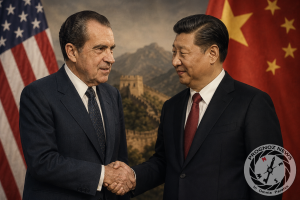
Richard Nixon occupies a curious place in modern Chinese history. To most Americans, he remains a figure of contradictions: the architect of détente with the Soviet Union, the president who ended direct American involvement in the Vietnam War, and the disgraced politician who resigned in the wake of Watergate. To the leadership of the People’s Republic of China, however, Nixon is remembered above all for one extraordinary act: his decision to travel to Beijing in February 1972 and begin the process of normalising relations between two nations that had spent over two decades treating one another as mortal enemies.
What, then, might Xi Jinping have thought of Richard Nixon?
Any answer must necessarily be speculative. Xi Jinping has rarely spoken extensively about Nixon himself. Yet Xi’s speeches, his view of history, and the priorities of the contemporary Chinese state provide enough evidence to make an informed assessment. Xi would almost certainly have regarded Nixon as a flawed man but a great statesman, a leader whose strategic vision transcended ideology and whose willingness to challenge established assumptions transformed the international order.
The first quality Xi would likely admire is Nixon’s realism.
Contemporary Chinese political thinking is deeply influenced by the notion that international relations are governed not by sentiment but by power, interests and long-term national objectives. Although modern Chinese officials often employ the language of international cooperation and mutual benefit, they also display a profoundly realist understanding of geopolitics. Nixon approached China in precisely this fashion.
During the late 1960s and early 1970s, the United States and China were ideological adversaries. American troops had fought Chinese forces in Korea. Mao Zedong’s government denounced American capitalism as imperialist oppression. Yet Nixon recognised that a widening Sino-Soviet split created an opportunity to reshape the global balance of power. Rather than viewing international affairs as a moral contest between political systems, he viewed them as a strategic competition amongst states.
Xi Jinping frequently invokes the concept of strategic patience and long-term planning. Nixon’s opening to China exemplified both. He was willing to endure criticism from anti-communist supporters because he believed that the interests of the United States required engagement with Beijing. Xi would almost certainly respect such a decision. In Chinese political culture, leaders are often judged not by their popularity but by their ability to advance the nation’s interests over decades rather than electoral cycles.
Xi might also admire Nixon’s intellectual seriousness.
Nixon was one of the most widely read American presidents. He approached foreign policy with unusual depth and often demonstrated a sophisticated understanding of history. Chinese leaders traditionally place considerable value upon intellectual achievement and historical knowledge. Xi himself frequently quotes Chinese classics and historical figures to explain contemporary policy. He often presents political leadership as requiring broad historical understanding.
Nixon’s diplomatic breakthrough emerged from precisely this sort of historical perspective. He recognised that China was not merely a communist state but a civilisation with thousands of years of history. He understood that China’s long-term importance would eventually outweigh short-term ideological disputes. This recognition stands in stark contrast to many Western policymakers who viewed China solely through the lens of Cold War ideology.
Xi would likely regard Nixon’s willingness to understand China on her own terms as evidence of genuine statesmanship.
Nevertheless Xi would probably view Nixon as a representative of an era of American leadership that has largely disappeared.
The generation of Nixon, Henry Kissinger and Zhou Enlai practised what might be called grand strategy. They were willing to negotiate with rivals, accept ambiguity and pursue incremental progress. Their diplomacy focused on reshaping entire geopolitical systems rather than winning immediate political victories.
Xi frequently contrasts long-term strategic thinking with what Chinese officials characterise as the short-term nature of Western democratic politics. From Beijing’s perspective, contemporary American politics often appears consumed by domestic polarisation and electoral competition. Nixon, whatever his faults, belonged to a generation of leaders who thought in terms of decades.
Indeed Xi may regard Nixon with a degree of nostalgia. Not because Nixon was friendly to China, but because he was predictable. He represented a school of diplomacy that accepted the legitimacy of rival powers and sought accommodation where interests overlapped.
This does not mean Xi would consider Nixon a friend of China.
Chinese leaders generally do not interpret history through personal relationships. Nixon’s opening to China is understood in Beijing as a strategic decision designed primarily to advance American interests. The rapprochement weakened the Soviet Union, strengthened America’s position in the Cold War and created new leverage in international diplomacy.
Xi would undoubtedly recognise this reality. Chinese official historiography tends to portray foreign leaders as pursuing national interests rather than acting out of goodwill. Nixon is respected because he understood China’s importance and adjusted American policy accordingly, not because he sought China’s success for its own sake.
There is another aspect of Nixon’s legacy that may resonate particularly strongly with Xi: the idea that national rejuvenation requires engagement with the outside world.
When Nixon visited China in 1972, the country remained poor, isolated and traumatised by the Cultural Revolution. Few observers imagined that China would become one of the world’s largest economies within half a century. Yet Nixon’s opening created conditions that eventually facilitated China’s integration into global markets and international institutions.
Xi’s signature political concept is the “great rejuvenation of the Chinese nation”. He presents contemporary China as a civilisation returning to her historical position after a period of weakness and foreign domination. The diplomatic opening initiated by Nixon occupies an important place within this narrative because it helped create the international environment in which China’s rise became possible.
Xi would therefore see Nixon as one of the foreign leaders who inadvertently contributed to China’s resurgence. Not intentionally, perhaps, but nevertheless significantly.
Yet admiration would likely be accompanied by caution.
Xi’s broader worldview is shaped by the conviction that great powers inevitably compete. From Beijing’s perspective, the United States initially welcomed China’s economic growth but became more hostile once Chinese power approached a level capable of challenging American primacy. Nixon’s rapprochement is therefore viewed not as a permanent reconciliation but as one chapter in a longer historical process.
Xi might conclude that Nixon understood geopolitical realities better than many contemporary American politicians. Nixon recognised that coexistence with China was necessary. He understood that China could not be isolated indefinitely. Whether Xi believes today’s American leadership shares that understanding is another question entirely.
Perhaps the most revealing comparison is between Nixon and Xi themselves.
Both men emerged from political systems undergoing profound internal tension. Both cultivated images as students of history. Both viewed international affairs through the lens of national power rather than ideological purity. Both demonstrated a willingness to pursue policies that appeared controversial in the short term but which they believed served long-term strategic objectives.
Of course their political systems, values and objectives differ profoundly. Yet Xi would likely recognise in Nixon a familiar type of leader: the strategist who seeks to shape history rather than merely react to it.
For that reason, Xi Jinping would probably remember Richard Nixon not primarily as the president who fell because of Watergate, nor as a symbol of American democracy’s failures, but as a statesman who understood the deeper currents of international politics. He would see a leader who grasped that the world was changing and who possessed the courage to alter course accordingly.
In the Chinese historical tradition, rulers are often judged less by their personal virtues than by their lasting impact upon the trajectory of the state. By that standard, Nixon’s journey to Beijing in 1972 ranks amongst the most consequential diplomatic acts of the twentieth century.
Xi Jinping would almost certainly recognise that fact. Whether he would admire Nixon personally is uncertain. That he would respect his strategic vision is far more likely.
144 Views



Most Readings