President AOC?
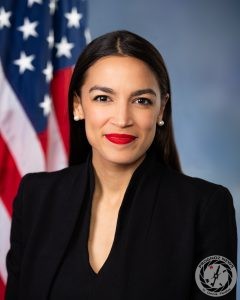
By Matthew Parish, Associate Editor
Thursday 20 August 2026
There are few politicians in the United States who generate quite as much excitement — or quite as much irritation — as Alexandria Ocasio-Cortez. This is itself an achievement. Most members of the United States House of Representatives are essentially unknown outside their districts. Ocasio-Cortez, universally abbreviated to “AOC”, became a national political personality almost immediately after defeating the veteran Democratic Congressman Joe Crowley in a 2018 primary. Eight years later, at the age of 36, she is one of the most recognisable politicians in America and speculation that she might seek the Democratic presidential nomination in 2028 has become entirely serious. She has declined to rule out either a presidential campaign or a challenge for a United States Senate seat.
The interesting question is no longer whether she could run for President. Constitutionally she can, politically she can and financially she almost certainly could. The more interesting question is whether she would make a good President.
The answer is more complicated than either her admirers or her detractors might imagine.
Ocasio-Cortez’s greatest political asset is an increasingly rare one: she can communicate. Modern American politicians tend to speak a peculiar bureaucratic dialect assembled by consultants, pollsters, lawyers and communications directors. Every sentence has been tested until nothing remains in it capable of offending anybody — or interesting them.
Ocasio-Cortez speaks differently. She can explain political propositions in ordinary language, she understands contemporary communications media instinctively and she conveys the impression that she actually believes what she is saying.
That matters enormously in a President. Ronald Reagan had it. Bill Clinton had it. Barack Obama had it. Donald Trump has it in an altogether different register. The Presidency is not merely the chief executive office of the American federal government. It is the principal narrative office of the Republic. Presidents explain to Americans who they are, what their problems are and what they should collectively do about them.
Ocasio-Cortez might be very good at that.
Her second advantage is generational. American political leadership has suffered from an extraordinary gerontocracy. The country that dominates artificial intelligence, biotechnology, software and much of global finance has nevertheless spent much of the twenty-first century being governed by people whose formative political experiences occurred before the internet existed. Ocasio-Cortez belongs unmistakably to the contemporary world. Her political vocabulary encompasses rent, student debt, precarious employment, healthcare costs, climate anxiety and the deterioration of economic security among younger Americans.
These are not imaginary problems. Whether one accepts her solutions is another matter.
Her programme remains distinctly to the American left. Her campaign platform supports Medicare for All, extensive public housing programmes, stronger organised labour, a federal jobs guarantee, substantial criminal-justice reform and a dramatically more liberal immigration system. She also continues to associate herself with the Green New Deal and advocates a less interventionist American foreign policy.
The lazy criticism is therefore that she is a socialist and socialism does not work. The more serious criticism is that she has spent almost her entire political career advocating programmes without having to administer anything remotely resembling the machinery required to implement them.
This distinction is important.
Being an effective legislator, campaigner or political communicator is not the same thing as being an effective executive. A President must manage an administration containing millions of civilian and military personnel. She must appoint thousands of officials, negotiate with Congress, understand financial markets, respond to hurricanes, banking crises and epidemics, command the armed forces and make decisions involving nuclear weapons. She must occasionally choose between several dreadful alternatives at three o’clock in the morning.
Ocasio-Cortez has never been a Governor, mayor, cabinet secretary, military commander or chief executive of a substantial organisation. Her governmental experience has been entirely legislative. Since January 2025 she has served on the powerful House Energy and Commerce Committee, including its Energy, Health and Oversight and Investigations subcommittees, which undoubtedly broadens her substantive experience. Yet there remains an enormous difference between questioning an administrator and being the administrator.
This may be the most substantial objection to an AOC presidency.
There is also the problem of economics. Ocasio-Cortez is strongest when identifying failures of American capitalism. Housing really has become grotesquely expensive in many prosperous American cities. American healthcare really is extraordinarily costly. Economic growth really has disproportionately enriched owners of capital. Younger Americans really do face asset prices — particularly residential property — substantially less favourable than those enjoyed by their parents.
But diagnosing a disease is easier than prescribing the medicine.
Large programmes of federal expenditure must ultimately be paid for through taxation, borrowing, monetary consequences or some combination of the three. Rent controls can protect existing tenants while discouraging construction. Excessively aggressive taxation of capital can reduce investment or encourage its migration. Government employment programmes can become bureaucratic patronage systems. Universal healthcare can reduce administrative waste while simultaneously creating formidable fiscal obligations. The details matter and progressive politics sometimes has an unfortunate habit of treating the observation that a market has failed as sufficient evidence that government will succeed.
A President Ocasio-Cortez would need economically orthodox people around her who were prepared to tell her “no”.
The encouraging evidence is that she appears increasingly capable of political evolution. Her politics in 2026 are not quite those of the insurgent congresswoman of 2019. She has begun distancing herself from some of the rhetoric associated with the progressive politics of 2020, particularly around policing and the cultural politics commonly described as “woke”. This is plainly relevant to any attempt to construct a national coalition rather than merely dominate a safe Democratic congressional district.
Whether this represents maturity or opportunism depends upon one’s political sympathies. In reality successful democratic politicians usually practise both. Franklin Roosevelt, Lyndon Johnson, Reagan and Clinton were all ideological politicians who understood that governing requires compromise. The politician incapable of changing her mind is not principled; she is dangerous.
Foreign policy presents the greater uncertainty.
Ocasio-Cortez’s instincts are sceptical of American military intervention and critical of what she regards as the country’s history of “forever wars”. There is much to commend in scepticism about military adventures. Iraq and Afghanistan provide expensive monuments to the proposition that military superiority does not necessarily translate into political success.
Yet American Presidents do not have the luxury of conducting foreign policy entirely according to their preferred moral philosophy. The United States maintains treaty commitments across Europe and Asia. It confronts an expansionist Russia, an increasingly powerful China, recurrent instability in the Middle East, nuclear proliferation and the emergence of autonomous weapons and artificial intelligence as instruments of strategic competition. Sometimes restraint preserves peace. Sometimes restraint persuades an aggressor that aggression will be inexpensive.
An AOC presidency would therefore have to distinguish between anti-war politics and deterrence. They are not the same thing.
Ukraine would constitute a particularly revealing test. A progressive foreign policy centred upon human rights ought logically to sympathise profoundly with a democratic country defending itself against imperial conquest. Yet parts of the American left have traditionally regarded American military power itself as the principal object of suspicion. A successful President Ocasio-Cortez would have to escape that intellectual trap. Empires are objectionable irrespective of whether the imperial capital is Washington, Moscow or Beijing.
There is then the question of whether America would elect her.
This is far less absurd than it once sounded. She is now being treated seriously as a possible 2028 contender. Contemporary reporting describes her as one of the politicians positioned to inherit Bernie Sanders’s progressive movement, while her selective endorsements in the 2026 midterms demonstrate an attempt to build influence beyond her own district. Prediction markets are hardly prophecy, but by mid-August 2026 they were treating her as one of several leading possibilities for the Democratic nomination rather than as an eccentric outsider.
Her electoral difficulty would nevertheless be obvious. Republicans have spent years turning AOC into a shorthand expression for everything conservative America dislikes about the Democratic Party. That might prove advantageous in a Democratic primary and disastrous in parts of Pennsylvania, Wisconsin, Georgia or Arizona. A presidential election is not won by accumulating enormous majorities in Brooklyn and Queens.
But there is another possibility.
American politics periodically changes its vocabulary. Ideas that appear impossibly radical in one decade become conventional in another. Reagan did this from the right. Roosevelt did it from the left. Trump did something stranger: he transformed positions that Republican elites had considered politically disreputable into the organising principles of the party within a remarkably short period.
Ocasio-Cortez possesses at least some of this agenda-setting capacity. She does not merely choose positions within the existing political debate. She tries to move the debate itself.
That is the characteristic that makes her genuinely presidential material.
There is also something refreshing about the prospect of an American President who has known ordinary economic insecurity. Ocasio-Cortez worked as a bartender and waitress before entering Congress. The political class in modern democracies has become increasingly professionalised: university, political internship, think tank, congressional staff, elected office. Politicians talk endlessly about working people while increasingly having remarkably little experience of being one.
AOC does.
This does not make her right about economics, foreign policy or anything else. But it gives her an intuitive political understanding that cannot easily be acquired from briefing papers.
The final assessment must therefore be conditional.
Alexandria Ocasio-Cortez has several of the qualities of an excellent President: intelligence, unusual communications ability, political courage, tremendous energy, an understanding of younger generations and a coherent conception of what is wrong with American society. She also possesses something more elusive — the capacity to make people who had previously regarded politics as irrelevant believe that politics concerns them.
Her weaknesses are equally substantial. She has virtually no executive experience. Parts of her economic programme deserve much harder scrutiny than progressive political rhetoric ordinarily gives them. Her foreign-policy instincts have not yet been tested by responsibility for consequences. She carries ideological baggage from an era of progressive politics that alienated significant parts of the American electorate.
Yet all Presidents enter office inadequately prepared. Nothing actually prepares somebody to become President of the United States because there is no other job remotely like it.
The more revealing question is whether a politician learns.
Ocasio-Cortez at 36 appears more pragmatic than Ocasio-Cortez at 29. Recent reporting suggests that she is consciously reconsidering some of the political language of the earlier progressive movement while preserving its economic emphasis. If that trajectory continues — if she retains her concern for economic inequality while acquiring fiscal discipline, if she supplements moral foreign-policy instincts with strategic realism and if she learns to govern coalitions containing people who profoundly disagree with her — then she might make a formidable President.
If she does not, she might make a disastrous one.
That uncertainty is not an argument against her. It is precisely what makes her interesting.
The United States does not particularly need another President whose principal qualification is that he or she has spent thirty years preparing to become President. It needs somebody capable of understanding a country undergoing enormous technological, economic and social transformation and of explaining that transformation to its citizens.
Alexandria Ocasio-Cortez might be that person.
But before Americans give her the nuclear codes, it would be useful to discover whether she can run something.
5 Views



Most Readings