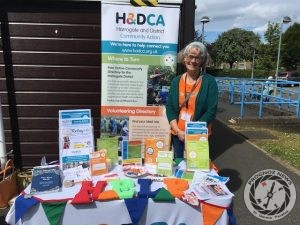
Harrogate & District Community Action: Supporting the Ukrainian community
By Matthew Parish
Saturday 29 August 2026
There are forms of solidarity that announce themselves dramatically — flags flying above public buildings, speeches of support, fundraising appeals and demonstrations in city squares. Then there is another kind, less conspicuous but ultimately just as important: finding somebody a room, helping a bewildered new arrival understand a form, introducing a refugee to a neighbour, locating an English class or explaining where to obtain advice when the British administrative system appears impenetrable.
It is in this second tradition of practical solidarity that Harrogate & District Community Action (HADCA) has made its contribution to Ukrainians displaced by Russia’s invasion. HADCA is an independent registered charity serving communities, charities and volunteers across the Harrogate district of North Yorkshire. Its ordinary work is broad: supporting voluntary organisations, encouraging volunteering, connecting people with community services and helping vulnerable or isolated people remain safe, well and connected. Yet the arrival of Ukrainians after February 2022 presented precisely the sort of challenge for which a strong local voluntary sector proves its worth.
The British response to Ukrainian displacement has been unusual. The Homes for Ukraine scheme depended to a remarkable degree upon ordinary households volunteering to accommodate people whom, in most cases, they had never previously met. The generosity involved was considerable. But generosity by itself cannot solve all the problems that follow when people traumatically displaced from their country arrive in an unfamiliar town. Hosts need advice. Guests need information. Children need schools. Adults need English lessons, employment and access to services. Families need to understand an unfamiliar bureaucracy. People need friends.
HADCA recognised this from the beginning. Its Ukraine information resources brought together guidance for sponsors and Ukrainians, information about accommodation and the Homes for Ukraine scheme, safeguarding and trauma resources and routes towards local assistance. It also helped connect volunteers with useful skills — including Ukrainian and Russian speakers and people with ESOL or language-teaching experience — to organisations needing their assistance.
This may sound administrative. In reality it is profoundly human. A refugee crisis is experienced by governments in numbers but by refugees in details. The question for a Ukrainian mother arriving in Yorkshire is seldom an abstract one about British refugee policy. It may be how she enrols her child in school. It may be where she can improve her English. It may be whether she can find work. It may simply be where she can meet somebody who understands what she has been through. The successful reception of refugees therefore depends upon innumerable small acts of competence and kindness.
HADCA has helped create the infrastructure within which those acts can occur.
An important feature of the Harrogate response has been collaboration rather than institutional rivalry. HADCA’s own resources directed Ukrainians and hosts towards the Harrogate District of Sanctuary and the Harrogate Ukraine Support Network, as well as towards Citizens Advice North Yorkshire and other local organisations. The Ukraine Support Network was established for individuals and groups assisting Ukrainian refugees and the families sponsoring them, creating a place where experience, contacts and practical information could be shared.
That collaborative instinct matters. The voluntary sector works best not when every charity attempts to do everything but when organisations know one another, exchange information and direct people towards whichever organisation can actually solve the problem before them. HADCA’s wider purpose is precisely to strengthen this connective tissue. Its Where to Turn directory brings together hundreds of charity services, support groups and community activities, while its volunteering services connect people who wish to help with organisations that need them.
For Ukrainian refugees this networked approach has particular value. HADCA continues to direct Ukrainian guests and hosts towards the Harrogate and Knaresborough Ukraine Support Network, whose resources cover activities and events, learning, skills and employment as well as information extending from first arrival towards longer-term integration. The emphasis upon integration is important because the character of Ukrainian displacement has changed with time.
In the first months after the full-scale invasion, everything seemed temporary. Ukrainians fled believing — or desperately hoping — that they might return within weeks or months. British hosts initially contemplated opening their homes for limited periods. Governments designed emergency schemes. Charities concentrated upon immediate necessities.
More than four years later, the moral landscape is different. Some Ukrainians have returned home. Others intend to do so when circumstances permit. But many have established lives in Britain while maintaining intense emotional, cultural and familial connections with Ukraine. Children have grown up speaking English with Yorkshire accents. Adults have found jobs. Friendships have formed. The distinction between “refugee” and “neighbour” has gradually become less meaningful.
This is one of the reasons why HADCA’s model is so valuable. Its work is not based exclusively upon the idea of refugees as passive recipients of charity. Its stated values include empowerment, participation, social justice and collaborative working. These are good principles for refugee integration because Ukrainians arriving in Britain are not merely people who need things. They are people with skills, professions, families, ambitions and a powerful desire to recover control over lives violently disrupted by war.
The objective of good refugee policy should therefore be independence rather than permanent dependency. English lessons matter because language permits independence. Employment support matters because work restores dignity as well as income. Social networks matter because integration cannot be legislated into existence. Advice matters because somebody who understands the system can begin making their own decisions within it.
There is also something admirable about the character of the community into which Ukrainians have arrived. Harrogate may be known internationally for its elegant architecture, spa-town history, gardens and the prosperous landscapes of North Yorkshire. But communities reveal their character most clearly when strangers arrive unexpectedly in need of help. Across the Harrogate district, households opened their doors. Volunteers offered their time. Local organisations created networks. People raised money and provided practical assistance. HADCA recorded, for example, local fundraising efforts in which Harrogate Brigantes Rotary Club and its supporters raised thousands of pounds for Ukraine-related causes.
None of this ends the war. It does not intercept a missile over Kyiv, rebuild an apartment block in Kharkiv or return an abducted child to their parents. Yet it addresses another battlefield created by Russian aggression — the attempt to scatter Ukrainian lives and destroy the ordinary structures through which people obtain security, community and hope.
There is a tendency in discussions of Ukraine to concentrate upon the grand questions. How many artillery shells can Europe manufacture? What weapons will Washington supply? What sanctions will be imposed? Where will the front line stand? These questions are indispensable. But behind them lie millions of individual human stories, including those of people who did not choose to become symbols of geopolitics and would rather simply have continued their ordinary lives.
A civilised response to war must therefore operate simultaneously at the level of states and at the level of neighbours.
Britain has sometimes argued fiercely about refugees and immigration. Yet the reception of Ukrainians has also revealed another British tradition — voluntary association, local charity and civic responsibility. It is a tradition in which people do not wait for Whitehall to solve every social problem. Churches, charities, community groups, councils, volunteers and private households construct local networks of assistance themselves.
HADCA belongs squarely within this tradition. Its Harrogate Community House provides a practical centre for voluntary organisations, while its broader work supports charities and community groups throughout Harrogate, Knaresborough, Ripon, Nidderdale, Masham and Boroughbridge. Its activities extend far beyond Ukraine, from volunteering to services helping people remain independent and connected. That breadth is precisely why its Ukrainian work is significant. Ukrainians have not been placed in a separate charitable universe. They have been connected with the institutions of the community in which they now live.
This is integration in its healthiest form. It does not require Ukrainians to cease being Ukrainian. Nor should it. Britain benefits when newcomers retain their language, culture and attachment to their homeland while simultaneously becoming participants in British civic life. A Ukrainian family can celebrate Independence Day on 24 August, speak Ukrainian at home, worry about relatives in Dnipro or Odesa — and nevertheless become cherished members of a Yorkshire community.
Indeed, there is a lesson here for Europe more broadly. Refugee integration is often imagined as a government programme. Governments undoubtedly have essential responsibilities: immigration status, financial support, education, healthcare and housing all require public administration. Yet belonging cannot be issued by a government department. It develops when somebody recognises you in the street, when your children have friends at school, when you join a local organisation, when somebody knows whom to telephone if you need assistance and eventually when you become the person offering assistance to somebody else.
That is why small organisations and local networks matter so much. They occupy the space between the individual and the state — the territory in which civil society lives.
HADCA’s motto could scarcely be more appropriate to the Ukrainian experience: supporting communities, charities and volunteers to make the Harrogate district a great place to live and work. For Ukrainians forced from their homes, making somewhere new “a great place to live” is no trivial achievement. It means reconstructing some semblance of ordinary life after the extraordinary violence of displacement.
The people who undertake this work seldom appear on television. There are no medals for maintaining a community directory, introducing volunteers, circulating information or making sure that somebody knows where to seek help. Yet societies depend upon precisely these quiet forms of competence.
Ukraine’s struggle is ultimately about the right of ordinary people to live ordinary lives without being subjected to violence, dictatorship or conquest. In North Yorkshire, HADCA and the wider Harrogate voluntary community have defended that principle in their own characteristically modest way — not with grand declarations but with rooms, networks, information, introductions, volunteering and friendship.
There is considerable nobility in that.
And somewhere between Harrogate and Ukraine, across the thousands of miles separating a Yorkshire spa town from the cities and villages scarred by Russia’s invasion, a simple message has thereby been conveyed: you may have been driven from your home, but you need not be left without a community.
That is fine work indeed.
—
Harrogate & District Community Action is a registered charity (No. 1144758). Further information about its work, volunteering opportunities and community services is available from HADCA’s official website.
7 Views



Most Readings