The Canadians Who Stayed: Paul and Mac Hughes and the Work of HUGS Kharkiv
By Matthew Parish
Thursday 3 September 2026
There are many ways of supporting a country at war. Governments issue communiqués. Diplomats attend conferences. International organisations commission reports. Charities organise appeals in comfortable cities thousands of kilometres from the front. Then there are people who simply arrive, discover what needs doing and do it. Paul Hughes belongs emphatically to the latter category.
The Canadian veteran came to Ukraine from Calgary in March 2022, just days after Russia began its full-scale invasion. He had initially contemplated fighting. Instead he discovered something that anyone who has spent much time in wartime Ukraine eventually understands: a modern war requires an enormous civilian infrastructure behind the soldiers. Somebody must evacuate the elderly from villages being shelled. Somebody must find medicine. Somebody must repair the battered vehicles upon which soldiers and volunteers depend. Somebody must look after displaced children. Somebody must drive down roads that sensible people are driving away from.
So Hughes stayed.
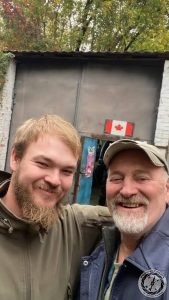
What emerged was HUGS, Helping Ukraine Grassroots Support, the Kharkiv-based organisation founded by Paul and his son Mac Hughes. It is a peculiarly appropriate name because HUGS represents something that the international response to Ukraine sometimes lacks: intimacy. This is humanitarian assistance conducted not at the level of policy but at the level of individual human beings.
HUGS describes itself as a Canadian NGO operating from Kharkiv and records that volunteers of almost 40 nationalities have participated in its work. But statistics convey only a small part of what the organisation has become. Its activities have included evacuating civilians from frontline settlements, delivering food, medicine, clothing and other necessities, supporting clinics, assisting internally displaced people and maintaining vehicles used by soldiers and humanitarian volunteers. Its SMART programme, devoted to Sports, Music, Art, Recreation and Technology, was created to give displaced Ukrainian children some fragments of ordinary childhood amid a war that has taken ordinary life away from them.
Then there is the garage.
This may seem an unglamorous detail until one understands Ukraine. Vehicles are consumed by this war at an extraordinary rate. Roads are appalling. Suspension breaks. Engines fail. Tyres are shredded. Cars and vans travel constantly between cities and frontline settlements carrying people, ammunition, medical equipment, food and everything else a country at war requires. A broken vehicle in Birmingham is an inconvenience. A broken vehicle close to the Ukrainian front may mean that wounded soldiers cannot be evacuated or civilians cannot escape an approaching Russian assault.
By 2024, more than 300 military and volunteer vehicles had passed through the HUGS workshop in Kharkiv for free repairs. Ukrainian public broadcaster Suspilne reported that Paul and his team had undertaken hundreds of missions into frontline areas of Kharkiv and Donetsk regions. HUGS became one of those institutions characteristic of wartime Ukraine: improvised at first, held together by personalities rather than bureaucracy, then gradually indispensable because it works.
Paul Hughes also became a Kharkivets by adoption. Kharkiv has this effect upon people. It is an intellectual city, an industrial city and a university city sitting absurdly close to the Russian frontier. Since February 2022 it has endured missiles, glide bombs, drones, blackouts and repeated Russian attempts to terrorise its inhabitants into abandoning it. Yet Kharkiv persists. Hughes has described it as his second home and has spoken of the quality that perhaps defines the city better than any other: however badly people suffer, they continue helping one another.
There is something revealing about a foreign volunteer who arrives during an emergency and is still there years later. The first months of the invasion produced an extraordinary international mobilisation. Ukraine attracted adventurers, idealists, former soldiers, journalists, doctors, engineers, fantasists and heroes. Some stayed for weeks. Some stayed for months. Inevitably the world’s attention wandered elsewhere.
Paul Hughes did not.
Four years into the full-scale war he was still in eastern Ukraine, describing the misery he encountered while distributing humanitarian assistance. This distinction matters. Courage is sometimes a single decision made in a few seconds. Commitment is making essentially the same decision every morning for four years. But the story of HUGS is also the story of a father and his son.
Mac Hughes came to Ukraine as a very young man. At first he joined his father in humanitarian work. He helped evacuate civilians, deliver supplies and support communities near the front. In southern Ukraine he spent months working around Kherson, one of the most dangerous humanitarian environments in the country after its liberation, as Russian forces continued bombarding settlements from across the Dnipro.
War has a way of accelerating lives. Experiences that might ordinarily accumulate over decades are compressed into months. Mac eventually decided that humanitarian work was no longer enough for him. One of his close friends, British volunteer fighter Sam Newey, was killed. Mac subsequently joined the Armed Forces of Ukraine, serving in a formation incorporating foreign volunteers and deploying in areas including Zaporizhzhia and Kharkiv.
It is worth considering what that decision means. Mac Hughes is Canadian. Ukraine was not his country. No mobilisation officer was going to arrive at his door in Calgary. He could have gone home. He could have built an ordinary life in Alberta and nobody could reasonably have criticised him for doing so. He had already done considerably more for Ukraine than almost anyone his age outside the country. Instead he enlisted.
On 1 July 2025, Canada Day, Mac’s position in the Zaporizhzhia region came under Russian drone attack. A drone exploded nearby. A vehicle was displaced by the blast and trapped him. Burning fuel set his legs alight. Mac later recalled asking his comrades to shoot him rather than leave him to burn to death. They refused. They pulled him out. He survived with second and third-degree burns over roughly a third of his body. There followed hospitals, operations, skin grafts and an exceptionally painful rehabilitation. For 53 days he could not walk.
There is a temptation when writing about war to romanticise wounds. One should resist it. There is nothing romantic about severe burns. There is nothing romantic about skin grafts, damaged nerves, hospital wards or learning to walk again. Heroism does not make pain hurt less. The significance lies elsewhere. Mac survived and began rebuilding himself.
By February 2026 he was walking again and approaching the point at which he could run, notwithstanding further surgery and continuing problems with one leg. In June he received the Ukrainian Canadian Sacrifice Medal, an honour for Canadians killed, wounded or missing while serving with Ukrainian forces. He was reported to be the eighteenth recipient. He had also previously received a bravery decoration from the head of Ukrainian military intelligence.
And then came the detail that says more about Mac Hughes than any medal could. He went back to his unit. By June 2026 Paul was reporting that his son had rejoined his unit in Kyiv and continued serving Ukraine. There are people who talk about courage. There are people who demonstrate it once. And there are a very small number who, after discovering precisely what war can do to the human body, choose to return. Mac Hughes is one of them.
The story of Paul and Mac also illuminates something larger about Ukraine’s war. Western discussion increasingly treats the conflict as an abstraction. We debate percentages of GDP spent upon defence, ranges of missiles, negotiating positions, sanctions packages and hypothetical peace settlements. All these things matter. But underneath them is a simpler moral reality.
Russia invaded another country. Ukrainians decided not to surrender. Other people, including foreigners with no legal obligation to do so, decided to help them. The Hughes family represents both halves of that international response. Paul represents the civilian volunteer movement without which wartime Ukraine could scarcely function. These organisations inhabit the space between the state, the military and ordinary people. They are small enough to improvise, courageous enough to go where large organisations sometimes cannot and sufficiently embedded in local communities to know who actually needs assistance.
Mac represents something rarer still: the foreigner who concluded that solidarity ultimately meant accepting the same physical risks as Ukrainians themselves. Neither kind of service should be sentimentalised. HUGS does not eliminate the suffering of Kharkiv. One repaired vehicle will not defeat Russia. One evacuation does not empty a threatened city. A children’s programme cannot restore the childhood that Russian missiles have interrupted. Humanitarian work in Ukraine often consists of solving one small problem while surrounded by a thousand enormous ones.
Yet this is precisely why it matters.
Civilisation is ultimately maintained through innumerable acts of practical decency. Fix the vehicle. Find the medicine. Feed the displaced family. Give the child somewhere to paint. Drive into the village. Bring the grandmother out. Help the soldier. Do it tomorrow again.
Paul Hughes once explained his presence in Ukraine in characteristically uncomplicated terms: he believes in freedom and dislikes bullies. There are libraries of political philosophy that arrive, by more circuitous routes, at approximately the same conclusion.
There is also something profoundly Canadian about the story. Canada possesses one of the world’s largest Ukrainian diasporas, and the connection between the two countries is older than the present war. Yet Paul and Mac Hughes have transformed solidarity from a historical sentiment into something immediate. They have placed Canadian lives, labour and courage directly alongside Ukrainian ones. Kharkiv understands such gestures.
It is a city in which people remember who stayed. When the history of this war is eventually written, attention will naturally concentrate upon presidents and generals, offensives and retreats, weapons systems and diplomatic conferences. But there will be another history beneath the official one: the history of thousands of people who saw a catastrophe unfolding and decided that they personally were going to do something about it.
HUGS belongs to that history. So does Paul Hughes, the Canadian who arrived expecting to help Ukraine and found another home in Kharkiv. And so does his son Mac, who began as a humanitarian volunteer, became a Ukrainian soldier, was grievously wounded, learned to walk again and returned to serve. Ukraine has produced many definitions of heroism since February 2022. Perhaps one of the best is also one of the simplest. You come when you are not obliged to come. You stay when you are free to leave. And, when circumstances permit, you get back up.
—
For readers who want to learn about or support the organisation, the official HUGS Ukraine website provides its programmes and current information.
6 Views


Most Readings

Crimea Under Pressure: Ukraine’s Long Campaign Against Russia’s Southern Bastion
97 Views