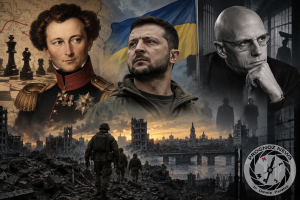
Clausewitz, Foucault and Ukraine: When War Becomes Politics and Politics Becomes War
By Matthew Parish
Monday 7 September 2026
There are two famous propositions about war and politics, and the war in Ukraine provides an unusually terrible laboratory in which to test them. The first belongs to Carl von Clausewitz:
War is the continuation of politics by other means.
The second is associated with Michel Foucault, who deliberately reversed the proposition:
Politics is the continuation of war by other means.
At first sight these appear to be opposites. Clausewitz tells us that politics comes first and war follows when ordinary political instruments prove inadequate. Foucault suggests almost precisely the reverse — that beneath the institutions, laws, negotiations and apparent tranquillity of political society lie relationships of force established through conflict. Peace does not necessarily abolish war. It may merely institutionalise its outcome. Ukraine suggests something more disturbing. Both propositions may be true. Indeed the longer the Russo-Ukrainian war continues, the harder it becomes to determine where politics ends and war begins.
Clausewitz’s world
Clausewitz’s famous observation is frequently quoted somewhat more crudely than he intended it. His argument was not merely that governments sometimes resort to violence when diplomacy fails. It was that war remains fundamentally subordinate to political purpose.
In On War, Clausewitz describes war as a political instrument — the political objective remains the purpose while warfare provides the means. Elsewhere he develops the point more subtly: political intercourse does not cease when fighting begins. War possesses its own grammar, as it were, but not its own logic.
That distinction is extraordinarily important. An army may capture a hill because doing so has tactical value. It may destroy a bridge because doing so interrupts an enemy supply line. It may encircle a city because this facilitates an operational breakthrough. But none of these things explains why the war is being fought. That question is political.
Clausewitz therefore warns us implicitly against the seductive idea that wars possess autonomous military solutions. The purpose of destroying the enemy’s army is ultimately to impose some political condition upon the enemy. And the Russo-Ukrainian war is profoundly Clausewitzian.
Russia did not invade Ukraine in February 2022 because Russia had some abstract desire to conduct combined-arms manoeuvres across the Ukrainian steppe. Tanks, artillery, missiles and infantry were instruments intended to produce a political result. The political objective was to alter the character of the Ukrainian state. Moscow sought, in different formulations and at different moments, to prevent Ukraine’s integration with Western political and security structures, to impose limitations upon Ukrainian sovereignty, to acquire or retain Ukrainian territory and to establish Russian predominance over Kyiv’s strategic choices.
The precise objectives have evolved as military circumstances have changed. But that is itself Clausewitzian. Political objectives determine military operations — while military possibilities simultaneously constrain and modify political ambitions.
The failure to capture Kyiv in 2022 changed Russian political objectives because it changed what Russian military power could plausibly achieve. Likewise Ukraine’s political objective — survival as a sovereign European state — determines her military strategy. Ukraine does not defend trenches in Donetsk Oblast because possession of any particular tree line represents some metaphysical good. It does so because territorial defence contributes towards the preservation of Ukrainian sovereignty.
A drone striking a Russian oil refinery is therefore political. An interceptor destroying a Shahed is political. A Ukrainian infantryman holding a position outside Kramatorsk is engaged, in Clausewitz’s sense, in politics. The instruments are explosive rather than parliamentary, but the underlying dispute concerns the organisation of political space. Who governs Ukraine? Where are Ukraine’s borders? May Ukraine choose her alliances? Can Moscow exercise a veto over Kyiv’s foreign policy? These are political questions. People are dying because the parties disagree about the answers.
Then comes Foucault
Yet Clausewitz does not exhaust what Ukraine teaches us. Michel Foucault’s inversion emerged most famously from his 1975–76 lectures at the Collège de France, subsequently published as Society Must Be Defended. Foucault asked whether relations of political power might be understood through the language of conflict, confrontation and war. His inversion was therefore not merely a clever play upon Clausewitz.
Suppose peace is not really the opposite of war. Suppose political institutions preserve relationships of force created by earlier struggles. Then the apparent tranquillity of political order may conceal the continuation of conflict. Courts, borders, constitutions, property arrangements, bureaucracies and political institutions may embody victories and defeats accumulated over generations. The battlefield disappears. The relationship of power remains.
Foucault described political power as continually reinscribing relationships of force into institutions, inequalities, language and even individual bodies.
Ukraine makes this idea considerably less abstract. Consider occupied Ukrainian territory. When Russian soldiers enter a Ukrainian town, that is obviously war. But what happens afterwards? The military checkpoint becomes an administrative boundary. Russian passports are distributed. Schools adopt Russian curricula. Russian law replaces Ukrainian law. Elections or referendums are organised. Property records are altered. Local officials are replaced.
Political prisoners are prosecuted before courts established by the occupying authorities. Children are taught different versions of history. These are apparently acts of government rather than combat. Yet they consolidate the political relationships produced by military force. Recent reporting from occupied Ukraine continues to describe Russian curricula, political repression, Russian electoral processes and administrative integration being imposed upon occupied territories.
Here Foucault becomes indispensable. The artillery has created a relationship of power.
Administration preserves it. War has become politics.
The dried blood inside institutions
This is one of Foucault’s most provocative insights. We tend to imagine law as the alternative to violence. First there is disorder and conflict; then institutions emerge and violence disappears. Foucault asks us to consider whether this chronology is misleading. The institution may instead preserve the result of violence.
A border on a map may represent the outcome of a forgotten war. A constitution may embody the settlement produced by a revolution. A property system may reflect victories accumulated centuries earlier. The violence disappears from view. The result remains. Ukraine understands this intuitively because Ukrainian history is filled with institutions constructed upon previous violence — imperial administration, Soviet collectivisation, deportation, Russification, population transfers, changing borders and eventually independence.
The current war is therefore partly a struggle over which historical settlement will prevail. Moscow insists, in different formulations, that Ukraine belongs within a Russian geopolitical sphere. Ukraine insists that the dissolution of the Soviet Union produced sovereign states whose independence is not conditional upon Russian approval. The dispute is historical. It is legal. It is geopolitical. And it is being settled with drones. Clausewitz would understand this immediately. But so would Foucault.
The front line is a political argument
There is something almost philosophically obscene about a modern military map. A coloured line runs through Donetsk Oblast. On one side stands one political authority. On the other stands another. Yet that thin cartographical line may correspond on the ground to kilometres of destroyed villages, trenches, mines, corpses, burnt vehicles and shattered forests.
The front line is therefore a political proposition written into geography through violence.
Russia says: this territory will be governed by us. Ukraine says: no, it will not. Everything else follows.
The extraordinary quantities of ammunition, drones, money and human life consumed along the front exist because neither political proposition has prevailed. This is Clausewitz in almost chemically pure form. But imagine that the guns eventually fall silent along approximately the same line. Checkpoints appear. Customs regulations develop. Different currencies circulate. Different schoolbooks are printed. Different courts exercise jurisdiction. Different television channels are watched. A military line becomes an administrative line. Then Foucault takes over. Yesterday’s battlefield becomes tomorrow’s institution.
This is why peace negotiations are so difficult
The philosophical distinction helps explain one of the central misunderstandings surrounding negotiations to end the war. Peace is often discussed as though it were simply the absence of shooting. It is not. Peace necessarily creates a political order. The contemporary negotiations demonstrate precisely this problem. Despite renewed American diplomatic activity, Russia and Ukraine remain divided over territory and the fundamental strategic status of Ukraine; Moscow continues to insist upon conditions concerning Ukrainian territory and NATO while Kyiv rejects arrangements it considers equivalent to surrender.
Hence the obsessive arguments about ceasefire lines, security guarantees, NATO, sanctions, recognition of occupied territories and the future strength of the Ukrainian Armed Forces. These apparently technical provisions determine what political relationship survives after military violence subsides. A ceasefire therefore does not necessarily abolish war in Foucault’s sense. It may institutionalise its temporary result. The trench becomes the negotiating position. The negotiating position becomes the treaty clause. The treaty clause becomes the border. The border becomes the school atlas. Eventually children are born who cannot remember why the border is there. The violence has become politics.
Yet Foucault can also mislead us
There is nevertheless a danger in Foucault’s formulation. If everything becomes war, then war ceases to mean anything. An election is not an artillery barrage. A tax assessment is not a missile strike. A parliamentary disagreement is not an infantry assault. Political rhetoric in peaceful Western societies frequently abuses military language — culture wars, wars on poverty, wars on drugs, political campaigns, electoral battlegrounds. Such metaphors obscure an elementary moral distinction between disagreement conducted through institutions and disagreement conducted by killing people.
Ukraine ought to cure us of this intellectual frivolity. Anyone who has experienced an air raid understands that literal warfare is different from metaphorical warfare. The distinction matters. Indeed Foucault himself subsequently became more cautious about reducing politics straightforwardly to war. His later reflections treated war and politics more as different ways in which unstable relationships of force might be organised rather than simply identical phenomena. That hesitation was wise. Because liberal politics exists precisely to prevent Foucault’s proposition from becoming literally true.
Politics is the alternative to killing
This may be the most important lesson Ukraine offers. Politics works when human beings agree to lose without dying. You lose an election. You lose a parliamentary vote. You lose a court case. You lose an argument. And nevertheless you continue participating in the political community.
This is civilisation’s extraordinary achievement. The defeated party does not assemble artillery outside parliament. The losing litigant does not launch FPV drones at the courthouse. Power changes hands without corpses. Politics therefore transforms potentially violent struggles into procedures. Foucault was right that relationships of force remain inside those procedures. People still struggle for power. Institutions still distribute advantages. Political actors still employ strategies and coalitions.
But the distinction between political competition and physical violence is not trivial. It is one of humanity’s greatest inventions. Ukraine’s tragedy arose because relations between Russia and Ukraine ceased to be governed exclusively through these political mechanisms.
Russia decided that Ukrainian political choices could be overridden through physical force.
At that moment Clausewitz returned.
And yet politics never disappeared
One of Clausewitz’s deepest insights is that even during war politics continues. The current diplomatic manoeuvring illustrates the point. American envoys have again been moving between Moscow and Kyiv while military operations continue, with recent discussions producing no evident breakthrough. Diplomacy and violence therefore occur simultaneously. A battlefield advance affects negotiating leverage. A sanctions package affects military production. A Ukrainian strike against Russian energy infrastructure affects economic calculations.
Western military assistance affects Russian diplomatic expectations. Russian drone attacks against Ukrainian cities seek not merely physical destruction but political consequences — exhaustion, fear, economic disruption and pressure upon the Ukrainian government.
Indeed recent Russian attacks on Kyiv have increasingly disrupted the ordinary rhythms of civilian life while long-range attacks by both sides continue alongside renewed diplomacy.
The battlefield and negotiating table are not separate universes. They communicate continuously. Clausewitz would have expected nothing else.
The Ukrainian synthesis
Ukraine therefore suggests that the apparent contradiction between Clausewitz and Foucault may be misleading. They describe different directions of travel. Clausewitz explains how politics becomes war. Political disagreement reaches a point at which one party attempts to compel another through organised violence. Foucault explains how war becomes politics. Relationships created through violence become embedded in borders, institutions, laws, identities and administrative practices. The process can therefore become circular: Politics → War → Political Settlement → New Politics → New Conflict.
This cycle can last generations. Ukraine has lived through several iterations of it. The Soviet political order was constructed partly through violence. Ukrainian independence emerged from the collapse of that order. The post-Soviet political settlement produced competing geopolitical orientations. Russia attempted to reverse Ukraine’s Western trajectory through pressure and eventually force. Military conflict then produced occupied territories and new political institutions within them. Politics became war. War became politics. Then politics produced more war. Clausewitz and Foucault meet somewhere outside Bakhmut.
The purpose of victory
This leads to a final uncomfortable conclusion. Military victory cannot be understood independently of the political order that follows it. Ukraine might destroy thousands of Russian vehicles, shoot down millions of drones and inflict extraordinary casualties upon Russian forces. None of these achievements constitutes victory by itself. Clausewitz reminds us why. Military success is meaningful only insofar as it secures the political object. For Ukraine that object is not the destruction of Russian soldiers. It is the preservation of a sovereign Ukrainian political community capable of determining its own future.
And Foucault supplies the corresponding warning. Whatever settlement emerges will crystallise relationships of power. The peace will not erase the war. It will contain it.
The front lines, sacrifices, alliances and victories of the conflict will survive inside whatever political institutions emerge afterwards. That is why the terms of peace matter so profoundly. A bad peace can preserve the logic that caused the war. A durable peace must change it.
War and peace
Clausewitz looked at the apparently irrational violence of war and discovered politics underneath it. Foucault looked at the apparently peaceful order of politics and discovered struggle underneath that. Ukraine teaches us to take both insights seriously without confusing them. War is not the opposite of politics. Nor is politics merely disguised warfare. Rather they are different mechanisms through which human beings resolve struggles over power.
The difference is that one mechanism permits compromise, ambiguity, delay and peaceful defeat. The other ultimately places human bodies against explosives. The achievement of civilisation lies not in abolishing political conflict — an impossible ambition — but in preventing political conflict from requiring physical destruction. That is why the deepest objective of Ukraine’s war cannot merely be victory on the battlefield. It must be the creation of a political order in which Russia no longer imagines that questions concerning Ukraine’s sovereignty can profitably be answered with tanks, missiles and drones.
Only then will Clausewitz’s process finally stop. And only then will Foucault’s begin — as the memory and consequences of the war are absorbed into borders, institutions, political identities and historical consciousness. Clausewitz explains why the war began. Foucault warns us that even when the shooting stops, the war will not entirely disappear. It will become history. And history is one of the most powerful forms of politics.
5 Views


Most Readings




Lenin’s Poisoned Legacy: Why History Should Remember Him as an Enemy of Humanity
93 Views