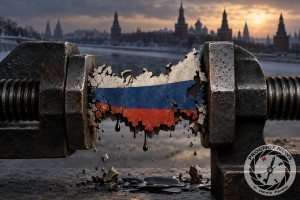
Tightening the Vice: How the West Could Bring Russia to the Negotiating Table
By Matthew Parish
Tuesday 8 September 2026
Sanctions have acquired a peculiar reputation during the Ukraine war. Whenever they fail to produce the immediate collapse of the country against which they are imposed, somebody declares that they have failed. Russia provides the obvious example. More than four years after the full-scale invasion of Ukraine, Moscow still exports oil. Russian factories still manufacture missiles. Russian banks still function. Vladimir Putin remains in the Kremlin. Russian soldiers continue advancing — slowly and at appalling cost — across portions of eastern Ukraine. Therefore, the argument goes, sanctions do not work.
This misunderstands both economics and coercion. The purpose of economic warfare need not be to bankrupt Russia. Indeed the West would be unwise to construct its strategy around an event as improbable as the sudden financial collapse of a vast nuclear-armed commodity producer with its own currency. The objective should instead be narrower and more realistic. It should be to change the price Putin attaches to another year of war.
That distinction matters enormously. The United States and Europe possess the means to make continuing the invasion progressively more expensive while simultaneously making peace progressively more profitable. But to achieve this they must stop thinking about sanctions principally as lists of Russian individuals whose villas have been frozen and begin thinking about them as a coordinated system for manipulating the economic choices available to the Kremlin.
This would amount to something approaching maximum financial pressure. It would not end the war tomorrow. But conducted intelligently, it might help make 2027 look sufficiently unpleasant in Moscow that the peace terms rejected in 2026 begin to appear considerably more attractive.
Sanctions are not punishment
The first conceptual change must concern what sanctions are for. Western sanctions policy has frequently mixed three different objectives. One is moral condemnation. Another is punishment. The third is coercion. Only the last of these is particularly useful for ending wars.
Punishment says: you invaded Ukraine, therefore you will suffer. Coercion says: if you continue invading Ukraine, your position will become progressively worse; if you stop, it can become progressively better. That second proposition is potentially far more powerful because it changes future incentives.
Scott Bessent’s meeting with Russian Finance Minister Anton Siluanov in Asheville on 31 August therefore deserves attention. According to Reuters, Bessent told Siluanov that there would be no economic concessions or agreements while Russia’s war continued. Siluanov had apparently attempted to explore areas of possible Russian-American economic cooperation. Bessent’s response was effectively that economic normalisation lies on the other side of peace.
That is exactly the correct framework. But it requires the threat on the other side to be credible as well. If Moscow refuses peace, things must become worse.
First, attack the margin rather than the barrel
Russia’s greatest economic vulnerability remains energy. Yet the West should resist the superficially attractive objective of preventing Russia from exporting oil altogether.
The reason is elementary economics. Suppose Russia exports ten barrels at $50 each.
Her revenue is $500. Now imagine sanctions remove five barrels from the world market, contributing to a shortage that raises the international price to $100. Russia somehow continues selling five barrels. Her revenue is still $500.
The sanctions have achieved remarkably little while making petrol more expensive for Western consumers. The better strategy is to keep Russian oil moving while reducing the amount Moscow receives for it. This was the intellectual logic of the oil price cap from the outset. The implementation has been imperfect because Russia developed an enormous network of tankers, insurers, traders, shell companies and intermediaries designed to circumvent Western restrictions. The appropriate response is not to abandon the concept. It is to attack the circumvention architecture.
Europe is already doing this. Its 21st sanctions package, adopted on 23 July 2026, added another 41 vessels to restrictions directed against Russia’s shadow fleet, taking the EU total above 670 vessels. It also extended restrictions to entities servicing that fleet, including, for the first time, a crewing agency. That approach should be expanded dramatically. But tankers themselves are only the beginning.
A tanker needs a flag. It needs classification. It needs insurance. It needs financing. It needs crews. It needs bunkering. It needs access to ports. Its cargo needs a buyer. The buyer needs a bank. The bank needs correspondent relationships. Payments must ultimately move through some financial architecture. Instead of chasing individual ships around the oceans, Western sanctions policy should attack the entire commercial ecosystem that makes the ships useful.
Make the shadow fleet expensive
The phrase “shadow fleet” makes Russia’s sanctions-evasion system sound mysterious.
It is not. Ships are enormous physical objects. They cannot disappear. Their ownership may be concealed behind companies registered in Dubai or Hong Kong. Flags can change. Nominal owners can be replaced. Cargoes can be transferred between vessels. But eventually somebody must insure the risk, somebody must receive the payment and somebody must unload the oil. Every stage represents a vulnerability.
Western governments should therefore create escalating penalties for companies knowingly servicing sanctioned Russian energy transportation. A port that repeatedly accommodates sanctioned vessels should face restrictions. A flag registry that persistently facilitates sanctions circumvention should find its vessels subjected to enhanced inspection and financial scrutiny. An insurer covering shadow-fleet tankers should risk losing access to Western reinsurance.
A bank financing repeated sanctions evasion should face restrictions upon dollar and euro transactions. A trading company established as a successor to a previously sanctioned company should be sanctioned rapidly rather than after eighteen months of bureaucratic investigation. The objective is not necessarily to stop the tanker sailing. It is to make every voyage cost more. If Russia must pay an additional $2 per barrel for shipping, another $2 for insurance, another $3 to compensate intermediaries for sanctions risk and another $5 discount to persuade buyers to accept a troublesome cargo, the oil can continue reaching the market while Moscow receives substantially less money.
That is the sweet spot of energy sanctions. The world gets the oil. Russia loses the margin.
Follow the money
The second front should be financial institutions outside Russia. This is where American participation becomes indispensable. The European Union can close European markets. The United States can threaten access to the dollar. Those are not equivalent powers.
For many banks around the world, the relevant calculation is brutally simple. How much profit do we earn facilitating Russian transactions? How much would we lose if the United States Treasury excluded us from the American financial system? For almost any significant international bank, the answer overwhelmingly favours Washington. The United States therefore does not need to prohibit every Russian transaction herself. She needs to persuade bankers in Dubai, Istanbul, Beijing, Hong Kong, Bishkek, Mumbai and elsewhere that facilitating Russian sanctions evasion may be commercially suicidal.
Europe has already begun moving in this direction. The July 2026 sanctions package imposed transaction bans upon 33 additional Russian banks as well as four banks outside Russia. It also targeted 14 third-country crypto-related platforms and provided mechanisms for further action against financial and cryptocurrency services facilitating sanctions circumvention. This is important because it moves sanctions towards their logical next stage. The first generation sanctioned Russians. The second sanctioned Russian companies. The third must sanction the foreigners who make the first two generations ineffective.
Secondary sanctions
This is the weapon Washington has historically wielded more effectively than Europe. A secondary sanction essentially says: You may trade with Russia. You may trade freely with the United States. But in certain circumstances you may not do both. For an obscure intermediary whose entire business consists of circumventing Russian sanctions, the choice is easy: it chooses Russia. For a substantial bank, shipping company or multinational enterprise, the calculation is very different. The American market is vastly more valuable. The dollar is vastly more useful. Access to American finance is vastly more important.
Hence secondary sanctions magnify American power because Washington does not need jurisdiction over every transaction. It merely needs jurisdiction over something the intermediary values more.
Bessent’s Treasury is currently demonstrating an aggressive version of this philosophy against Iran, threatening financial institutions and other foreign intermediaries with exclusion from American finance if they facilitate targeted Iranian activities. The lesson for Russia is obvious. Washington could apply substantially greater pressure to banks and trading networks that systematically facilitate Russian sanctions evasion. Indeed the most significant criticism of American Russia policy may be that it has not yet fully done so. Democratic senators complained in August that the administration had not imposed sufficient counter-evasion sanctions upon foreign banks and companies assisting Moscow.
That restraint may have been diplomatic. It should also be negotiable.
Bessent can tell Siluanov: Here is what happens if the talks succeed. And then: Here is what happens if they fail.
The China problem
There is, however, an obvious limit. China. Washington can credibly threaten a small Kyrgyz bank. Threatening one of China’s largest state-owned banks is a different proposition altogether. A confrontation involving major Chinese financial institutions could disrupt world trade, accelerate financial fragmentation and encourage Beijing to construct alternatives to the dollar system even more aggressively.
Maximum pressure therefore cannot mean maximum stupidity. China should be handled selectively. Washington should distinguish between ordinary Sino-Russian trade and entities deliberately established or deployed to circumvent sanctions against Russia’s military-industrial and energy sectors.Small Chinese banks heavily exposed to Russian business represent easier targets. So do specialist trading houses. So do companies exporting dual-use electronics. So do intermediaries whose business models depend disproportionately upon Russian sanctions evasion. The United States should make examples of selected offenders rather than attempt to sever China from Russia wholesale.
The message to Beijing should be: We are not asking China to join the Western alliance. We are asking Chinese institutions not to become the financial quartermasters of Russia’s invasion. China may not accept the moral premise. But Chinese banks understand commercial risk.
India is different
India requires another strategy. New Delhi has purchased enormous quantities of Russian oil since 2022 because the economics have been attractive. India is not Russia’s military ally.
She is pursuing Indian interests. Therefore Washington should avoid transforming Russian oil purchases into a grand confrontation about India’s strategic autonomy. Instead she should manipulate incentives.
Indian refiners should remain able to purchase Russian crude — provided the transaction suppresses Russian revenues. The objective should be to turn India into the world’s most ruthless negotiator with Moscow. Every new Western restriction upon shipping and finance increases Russia’s need for reliable buyers. That gives India leverage. New Delhi should use it.
If Russian Urals must be sold at an enormous discount to attract Indian refiners, the system is working. The West does not need India to stop buying Russian oil. It needs India to stop paying Russia very much for it.
Technology is the slow poison
Energy sanctions reduce current revenues. Technology sanctions damage future productive capacity. Russia can manufacture a great deal domestically. She cannot manufacture everything.
Modern warfare depends upon semiconductors, machine tools, optics, industrial software, specialist bearings, telecommunications equipment and innumerable sophisticated components embedded in global supply chains. Many reach Russia through third countries. This creates another target for enforcement. The West should stop focusing exclusively upon the Russian importer and identify the Western or Asian manufacturer whose products repeatedly appear in Russian weapons.
Serial numbers matter. Customs records matter. Distributor networks matter. When a particular component repeatedly appears in Russian missiles recovered in Ukraine, governments should trace the chain backwards. Who manufactured it? Who purchased it? Which distributor sold it? Through which country? Which bank financed the transaction?
Repeated leakage through the same intermediary should trigger progressively severe consequences.
The objective is not to prevent Russia obtaining every microchip. That is impossible.
The objective is to make every sophisticated component slower, more circuitous and more expensive to acquire. Modern industrial economies depend upon efficiency. Sanctions weaponise inefficiency.
Ukraine has an economic sanctions policy of its own
There is also a form of economic pressure that is not conventionally described as sanctions.
Ukraine’s long-range attacks upon Russian energy infrastructure. By late August 2026, repeated Ukrainian drone attacks had caused serious disruption to Russian refining capacity and contributed to fuel shortages in parts of Russia. Moscow has been forced to seek additional fuel supplies and alternative refining arrangements abroad.
This is economically significant. Russia possesses enormous quantities of crude oil. But crude oil and petrol are not interchangeable. Oil must be refined. Refineries are large, complicated and difficult to repair quickly when specialist equipment is destroyed. A Russia simultaneously trying to maintain domestic fuel supplies, supply its armed forces and preserve profitable energy exports faces difficult choices when refining capacity is disrupted.
Western financial pressure and Ukrainian attacks upon legitimate military-supporting energy infrastructure therefore operate upon different sides of the same equation. One reduces Russia’s revenue. The other increases Russia’s costs. The combination is substantially more powerful than either alone.
Freeze means freeze
Then there are Russia’s immobilised sovereign assets. These should be treated as negotiating capital. The West has spent years debating whether the principal itself can legally be confiscated, whether only extraordinary revenues generated from it should be used and what precedents outright confiscation might create for sovereign reserves. Those legal questions matter. But strategically the essential point is simpler. Russia wants the money back. Therefore do not give it back cheaply.
Any future peace arrangement should establish explicit conditions governing frozen Russian assets. Some portion may ultimately contribute to Ukrainian reconstruction. Some might remain immobilised against future Russian compliance. Some might eventually be released in stages. The crucial principle is conditionality. Russian assets should not suddenly become available because somebody signs a document in Geneva or Washington. Release should follow performance.
Build the sanctions staircase
This is perhaps the most important element of the entire strategy. Maximum pressure requires a maximum-pressure exit. Otherwise it becomes merely permanent economic warfare. Washington and Brussels should privately present Moscow with a detailed sanctions staircase. At each step Russia knows both the reward for compliance and the penalty for reversal.
A verified ceasefire might suspend selected new sanctions. Withdrawal or demilitarisation from an agreed zone might produce limited financial relief. Return of prisoners and abducted Ukrainian children could trigger another stage. Acceptance of international monitoring could trigger another. Implementation of agreed security arrangements could reopen selected commercial sectors. A sustained period without violations might eventually permit broader financial normalisation. Conversely a renewed invasion would produce automatic snapback. This should be written in advance. Not improvised after every dispute. Predictability makes coercion credible.
Europe must be in the room
None of this works if Washington negotiates sanctions relief that Europe refuses to provide.
This is a fundamental practical constraint upon any American-Russian peace diplomacy. The United States is extraordinarily powerful financially. But much of Russia’s pre-war economic relationship was with Europe. European sanctions control European assets, European ports, European markets and European companies.
The European Union’s 21st package demonstrates that Brussels is presently moving towards more pressure rather than less. It targeted over a hundred banks and crypto operators, dozens more shadow-fleet vessels and additional entities supporting Russia’s military-industrial system. Following the latest accusations of Russian hybrid activity in Germany, European governments are considering still further measures against Moscow’s military complex and shadow fleet.
Therefore Washington cannot credibly promise Moscow European sanctions relief unless Europe agrees. Nor should it. The peace negotiations need an economic track involving Washington, Brussels, London and Kyiv. They need not agree upon every rhetorical flourish. They must agree upon the staircase. Otherwise Moscow will simply attempt to separate them.
The oil price complication
There is another reason coordination matters. The world energy system in 2026 is unusually fragile. The conflict involving Iran has disturbed Middle Eastern energy flows and altered the economics of Russian crude. Indeed Chinese refiners are currently increasing purchases of Russian oil amid constrained Middle Eastern supplies.
The European Union recognised this problem when its July sanctions package suspended automatic adjustment of the Russian crude-oil price-cap mechanism until July 2027, subject to an interim review, because of exceptional disruption in world petroleum markets.
This illustrates why sanctions policy cannot simply consist of shouting “more”. Timing matters. Oil prices matter. Alternative supply matters. If Russian exports are squeezed too abruptly during a Middle Eastern supply crisis, Brent prices may rise sufficiently to compensate Moscow for reduced volumes. Economic warfare requires economists.
The West should tighten Russian oil restrictions most aggressively when alternative supply is abundant and prices are soft. When global markets are disrupted, pressure should concentrate upon financial intermediaries, military technology and margins rather than simply removing barrels. The objective is Russian pain. Not global recession.
How quickly could this work?
Probably not in weeks. Possibly in months. More plausibly over one to two years. Economic coercion rarely operates according to the dramatic timetable politicians prefer. Russia still possesses substantial adaptive capacity. She can increase taxes. She can borrow domestically. She can compel banks to support strategic companies. She can tolerate inflation. She can reduce civilian expenditure. She can accept deteriorating living standards. China will continue buying Russian commodities. Sanctions networks will continue evolving.
There will always be smugglers. The objective is therefore cumulative pressure. Imagine Russia entering 2027 with weaker energy revenues, still more expensive sanctions circumvention, restricted access to sophisticated technology, stressed corporate balance sheets, high borrowing costs and declining liquid fiscal reserves. Now add continuing Ukrainian attacks against military and energy infrastructure. Then add continued European financing of Ukraine. Then add continued American weapons supplies.
At that point Putin must ask a different question. Not whether Russia can continue fighting.
Of course she can. But what exactly is another year likely to achieve?
The territorial arithmetic
This is where economic warfare meets geography. Russia’s remaining maximalist objective in Donbas requires capturing territory Ukraine still controls. That territory contains fortified cities. Taking it requires soldiers, ammunition, vehicles and time. If Moscow believed those objectives could be achieved cheaply within three months, no sanctions package would persuade Putin to stop.
But if the Kremlin believes they require another eighteen months, hundreds of thousands more casualties and continuing economic deterioration, the calculation changes. The value of peace rises as the expected cost of victory rises. Western policy should therefore seek to ensure simultaneously that Ukrainian military resistance remains strong and Russian economic conditions deteriorate.
Neither instrument replaces the other. They multiply one another. A sanction is more persuasive when the Russian army is stuck. A fortified Ukrainian city is more strategically valuable when Moscow is paying 14 per cent interest rates. Economic pressure converts time into a Ukrainian weapon.
Do not threaten regime collapse
There is one thing Washington should emphatically avoid. The stated objective should not be destroying Russia. Nor overthrowing Putin. Nor dismembering the Russian Federation. Those threats would make compromise harder because they tell the Kremlin that peace offers no safety.
If Putin believes the West intends to destroy him regardless of what he does, then continued war becomes rational. The message must instead be extraordinarily precise. The West can live with Russia. It can trade with Russia. It can eventually invest in Russia. It can coexist with a Russian government it profoundly dislikes. What it will not accept is Russia attempting indefinitely to conquer Ukraine. That distinction creates an exit.
Maximum pressure, maximum opportunity
The phrase “maximum pressure” therefore risks being misunderstood. It should not mean imposing every conceivable sanction tomorrow. It means maximising the difference between Russia’s economic future under war and its economic future under peace. That requires two tracks running simultaneously. The war track becomes steadily worse.
Oil margins decline. Banks become nervous. Technology becomes harder to obtain.
Shadow-fleet operations become more expensive. Foreign intermediaries retreat. Assets remain frozen. Investment remains impossible. Russia becomes progressively more dependent upon China.
The peace track moves in the opposite direction. Sanctions relief. Asset negotiations.
Access to capital. Technology. Western markets. Foreign investment. Eventually perhaps American participation in Russian energy, mining, Arctic infrastructure and other sectors contemplated in the various peace discussions.
One road leads towards an increasingly isolated war economy. The other leads towards normality. The greater the distance between them, the more powerful the negotiation.
The most important audience is not Putin
There is a final subtlety. Economic pressure is not addressed solely to Vladimir Putin. It is addressed to the people around him. Finance Ministry officials. Central bankers. Energy executives. Bank chairmen. Industrialists. Regional governors. Technocrats. Members of the Russian elite whose fortunes and careers depend upon a functioning economy rather than another village in Donetsk Oblast.
These people do not necessarily oppose the war. Many may enthusiastically support it. But preferences have prices. A businessman willing to tolerate one year without access to Western capital may feel differently after five. A banker willing to absorb government-directed loans may become nervous when defaults increase. A governor may support mobilisation until collapsing civilian investment begins creating political problems. A Finance Minister may support the President while quietly explaining that another year’s budget is becoming considerably more difficult. This is how economic pressure enters political decision-making in an authoritarian state. Not necessarily through revolution. Through arithmetic.
Bessent’s real negotiation
This brings us back to Asheville. Scott Bessent and Anton Siluanov are unusually appropriate men to conduct this part of the peace process because they speak the same professional language. They understand yields. Reserves. Liquidity. Discounts. Capital flows. Risk. Neither needs to debate the medieval history of Kyiv.
Bessent’s task is instead to make Siluanov understand what Russia’s balance sheet might look like twelve months from now if the Kremlin rejects Washington’s proposal. Then he must show him the alternative balance sheet. One contains continued war expenditure, declining access to capital, sanctions, technological restrictions, frozen assets and ever greater dependence upon Beijing. The other contains peace and a gradual path back towards economic normality. Siluanov then takes those two spreadsheets home.
Perhaps Putin ignores them. Presidents frequently ignore Finance Ministers.
But wars are ultimately competitions in resources as much as competitions in courage. Russia has vastly greater resources than Ukraine. She does not have greater resources than Ukraine, Europe and the United States combined. That is the strategic fact Western policy has too often obscured.
If the West coordinates its financial power with Ukrainian military resistance, Russia does not need to collapse. She merely needs to conclude that the next year of war will be worse than the peace available today. That is how the vice works. Not with one dramatic turn.
Not with an economic knockout. One bank. One tanker. One refinery. One intermediary. One billion dollars. One month at a time. Until eventually the price of the next Russian advance exceeds the value Moscow attaches to making it.
At that moment sanctions will not have “defeated” Russia. They will have done something considerably more useful. They will have helped persuade her to stop.
8 Views



Most Readings




Lenin’s Poisoned Legacy: Why History Should Remember Him as an Enemy of Humanity
97 Views