The Fuel Blockade of Crimea and Its Effects
By Matthew Parish, Associate Editor
Wednesday 24 June 2026
Ever since Russia’s annexation of Crimea in 2014 Ukraine has sought ways to increase the costs of occupation while avoiding direct military confrontation on the peninsula itself. In the early years after annexation, the principal instruments were economic and infrastructural. Ukraine restricted water supplies through the North Crimean Canal, limited commercial links and, amid considerable controversy, saw the interruption of electricity supplies from mainland Ukraine. In the current phase of the war, however, a new form of blockade has emerged—one focused on fuel.
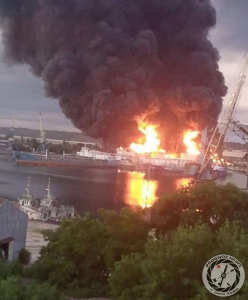
The contemporary fuel blockade of Crimea is not a blockade in the traditional naval sense. Rather it is the result of a sustained Ukrainian campaign against the logistical infrastructure upon which Russian control of the peninsula depends. Through attacks on oil depots, fuel storage facilities, refineries, rail links, bridges and transport routes, Ukraine has sought to make the movement of petroleum products into Crimea increasingly difficult and expensive. The objective is straightforward: to transform Crimea from a secure Russian military rear area into a logistical liability.
The significance of fuel in modern warfare cannot be overstated. Armoured vehicles, aircraft, naval vessels, generators, logistics fleets and civilian support services all depend upon a steady supply of petroleum products. A military force deprived of fuel rapidly loses mobility and flexibility. The Russian military presence in Crimea has long relied upon supply routes across the Kerch Strait, rail links through occupied southern Ukraine and fuel shipments from Russian refineries. By targeting these systems, Ukraine has attempted to attack not Russian combat units directly but the economic foundations that sustain them.
The effects have become increasingly visible. Reports throughout 2025 and 2026 described shortages of petrol and diesel across the peninsula, long queues at filling stations and increasingly restrictive rationing measures. Russian-installed authorities progressively limited civilian purchases before eventually suspending ordinary fuel sales altogether, reserving supplies for government and security purposes. In some locations, fuel sales were capped at very small quantities, while coupon systems were introduced in an effort to control distribution.
The consequences extend far beyond motorists. Tourism has historically been one of Crimea’s principal economic sectors. Visitors arriving by road require fuel. Hotels require electricity generated by fuel-powered backup systems. Food distribution depends upon trucking networks. As shortages intensify, economic activity contracts. Russian occupation authorities have already been forced to suspend or curtail various civilian activities, including tourism-related programmes and public events.
There is also an important psychological dimension. Since 2014, Moscow has invested substantial political capital in portraying Crimea as permanently and irrevocably integrated into the Russian Federation. Infrastructure projects such as the Kerch Bridge were intended to demonstrate that Russia could sustain the peninsula indefinitely without Ukrainian cooperation. Persistent fuel shortages undermine that narrative. When residents must queue for fuel, face restrictions on travel or experience disruptions to daily life, they are reminded that Crimea remains dependent upon vulnerable supply chains.
From a military perspective, the blockade serves an even more significant purpose. Crimea has become one of Russia’s most important military hubs in the war against Ukraine. It hosts air bases, naval facilities, logistics centres and missile-launching infrastructure. If fuel deliveries become uncertain, military planners must divert resources to protecting supply routes and stockpiling reserves. Every litre allocated to military operations is a litre unavailable for civilian consumption, creating tensions that occupation authorities must manage. The resulting competition for scarce resources places additional pressure on the occupation administration.
Ukraine’s approach reflects a broader strategic lesson that has emerged during the war. Direct assaults against heavily fortified positions are often costly and uncertain. Attacking logistics, by contrast, can produce cumulative effects over time. Fuel shortages rarely generate dramatic headlines comparable to major battlefield victories, yet they gradually erode an adversary’s capacity to operate. The campaign resembles a form of economic siege conducted through precision strikes rather than through encirclement.
Critics may argue that such measures impose burdens on civilians living in Crimea. That criticism carries some force. Civilian populations inevitably suffer when essential supplies become scarce. Yet from Kyiv’s perspective, Crimea remains sovereign Ukrainian territory under unlawful foreign occupation. Any logistical network supporting the occupation is therefore viewed as a legitimate target. Ukraine’s leaders have consistently framed strikes against energy and transport infrastructure as efforts to weaken the machinery of occupation rather than to punish civilians.
The fuel blockade must also be viewed alongside earlier Ukrainian efforts to restrict water and electricity supplies to Crimea. The history of the peninsula since 2014 demonstrates a recurring reality: Crimea is geographically dependent upon the mainland. Ukraine’s closure of the North Crimean Canal severely reduced agricultural production for years, while interruptions to electricity supplies highlighted the vulnerability of the peninsula’s infrastructure. Fuel shortages are merely the latest manifestation of the same strategic fact.
Whether the fuel blockade ultimately proves decisive remains uncertain. Russia retains substantial resources and has repeatedly demonstrated an ability to adapt to logistical difficulties. Nevertheless, the campaign has already achieved an important strategic objective. It has transformed Crimea from a secure rear area into a contested logistical space. Russian authorities are now compelled to devote increasing attention to sustaining the peninsula rather than exploiting it as an unquestioned base for operations against Ukraine.
In warfare logistics often determines outcomes more reliably than battlefield heroics. The fuel blockade of Crimea illustrates this principle with remarkable clarity. By targeting the infrastructure that enables occupation, Ukraine has shown that control of territory depends not merely upon military force but upon the continuous flow of resources. When that flow is disrupted, even a heavily militarised peninsula can begin to feel isolated. Crimea’s fuel shortages are therefore more than an economic inconvenience. They are evidence of a wider struggle over whether Russia can continue to sustain her most symbolically important territorial acquisition of the twenty-first century.
92 Views



Most Readings