The Silent Signals War: Inside the FSB’s Centre 16
By Matthew Parish, Associate Editor
Monday 13 July 2026
Amongst the many institutions that comprise the Russian Federation’s sprawling security apparatus, few are as little known yet as consequential as the Federal Security Service’s Centre 16. Overshadowed in popular imagination by the FSB’s political police functions, counter-intelligence directorates and domestic repression, Centre 16 occupies a different battlefield altogether. It is the organisation charged with intercepting, decrypting, analysing and exploiting communications. In an age in which information has become as decisive as artillery, Centre 16 has evolved into one of Russia’s most strategically important intelligence assets.
The origins of Centre 16 lie in the Soviet Union’s immense signals intelligence infrastructure. Throughout the Cold War, the KGB and Soviet military intelligence invested enormous resources in monitoring radio traffic, diplomatic communications, satellite transmissions and electronic emissions across the globe. Although the Soviet Union collapsed, much of that technical expertise survived. Rather than dismantling these capabilities, the Russian state modernised them, adapting traditional signals interception to the internet age. Centre 16 became one of the principal heirs to that legacy.
Signals intelligence differs fundamentally from espionage involving recruited agents. Instead of persuading human beings to betray secrets, it seeks to acquire information directly from the communications systems upon which governments, militaries, companies and individuals depend. Telephone calls, internet traffic, encrypted messaging platforms, satellite links, military radios and fibre-optic cables all become potential sources of intelligence. The challenge is not merely interception but interpretation. Vast quantities of electronic data possess little value unless analysts can identify meaningful patterns, priorities and vulnerabilities.
Centre 16 therefore combines mathematicians, linguists, engineers, computer scientists, cryptographers and intelligence analysts. Their work ranges from the highly theoretical to the intensely practical. Cryptographic specialists attempt to defeat foreign encryption systems. Network engineers study the architecture of communications infrastructure.
Analysts reconstruct organisational structures from intercepted traffic, identifying chains of command, operational procedures and emerging intentions. Increasingly, software engineers employ machine learning and automated processing to manage data volumes that would have been unimaginable even twenty years ago.
Russia’s domestic legal environment provides Centre 16 with extraordinary opportunities unavailable to many foreign intelligence services. The country’s telecommunications legislation requires internet service providers and telecommunications companies to install equipment enabling state interception of communications under the SORM system. While officially justified as a counter-terrorism and criminal investigation tool, SORM provides the Russian security services with a technical architecture that facilitates broad surveillance capabilities across domestic communications. Centre 16 is widely believed to play a significant role in exploiting this infrastructure alongside other specialised FSB directorates.
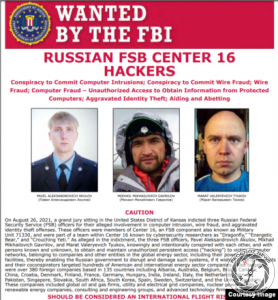
Internationally, Centre 16 has been associated by Western governments and cybersecurity researchers with sophisticated cyber-enabled intelligence operations. The distinction between cyber operations and signals intelligence has become increasingly blurred.
Penetrating a foreign computer network may serve not to sabotage it but to establish persistent access to communications flowing through it. Malware can function as a listening device just as effectively as a traditional microphone. Consequently electronic espionage increasingly merges classical intelligence gathering with offensive cyber capabilities.
The war in Ukraine has highlighted the critical importance of signals intelligence on both sides of the conflict. Modern warfare generates an immense electronic signature. Military headquarters communicate continuously with subordinate formations. Logistics systems transmit inventory data. Drones exchange video feeds with operators. Mobile telephones reveal troop locations. Satellite communications link dispersed commands. Every transmission potentially provides intelligence to an adversary capable of collecting and analysing it.
Russia entered the full-scale invasion expecting overwhelming superiority in many of these domains. Yet the conflict has demonstrated that technological sophistication alone cannot compensate for poor organisational discipline. Russian forces frequently exposed themselves through insecure communications, commercial mobile telephones and inadequate encryption procedures. Ukrainian intelligence, assisted by extensive Western support, repeatedly exploited these weaknesses. Centre 16 undoubtedly remains an important component of Russia’s efforts to restore its intelligence advantage, but the conflict has also illustrated the limitations of technical collection when operational security is weak.
Centre 16 also occupies an important place within Russia’s broader strategic competition with Western intelligence agencies. Institutions such as the United States National Security Agency, Britain’s Government Communications Headquarters and comparable European organisations pursue broadly similar missions, albeit under very different constitutional, legal and political frameworks. All recognise that information dominance increasingly determines geopolitical influence. The contest is therefore not simply one of military power but of computational capability, mathematical expertise, semiconductor technology and software engineering.
Artificial intelligence is transforming this competition still further. Traditional signals intelligence often required large numbers of analysts painstakingly reviewing intercepted communications. Today, automated systems can identify anomalies, translate languages, classify documents, reconstruct social networks and prioritise targets at extraordinary speed. Centre 16 is almost certainly investing heavily in such technologies, although Russia continues to face significant challenges in accessing the most advanced computing hardware owing to international sanctions and export controls. Human expertise remains indispensable, but increasingly it is augmented by algorithms capable of processing information at industrial scale.
An enduring misconception portrays organisations such as Centre 16 as omnipotent. The reality is considerably more complex. Signals intelligence produces fragments rather than complete pictures. Encryption continues to improve. Sophisticated targets adopt rigorous operational security measures. Deception operations deliberately generate false electronic signatures. Intelligence failures frequently arise not because information was unavailable but because analysts misunderstood its significance or policymakers ignored their assessments. The history of intelligence is replete with examples in which technical collection succeeded while strategic judgement failed.
Centre 16 therefore illustrates a broader truth about contemporary statecraft. Power increasingly resides not merely in armies, tanks or aircraft but in the invisible architecture of information. Nations compete to intercept data, secure their own communications and exploit the vulnerabilities of their adversaries. The battlefield has expanded into electromagnetic spectrum management, encryption standards, cloud computing, satellite constellations and undersea communications cables. Victory may depend as much upon mathematicians and software engineers as upon infantry or artillery.
As geopolitical rivalry intensifies, organisations such as Centre 16 are likely to become even more central to Russian national security planning. Their successes will remain largely invisible, while their failures may only become apparent decades later through declassified archives and memoirs. Yet their influence will continue to shape diplomacy, military operations and strategic decision-making in ways rarely appreciated outside the closed world of intelligence professionals.
The silent war of intercepted signals, broken codes and hidden algorithms has become one of the defining struggles of the twenty-first century. Centre 16 stands at the heart of Russia’s participation in that contest—less visible than conventional military formations, but no less significant in determining how information is gathered, how power is exercised and how conflicts are fought in an increasingly digital world.
62 Views



Most Readings



Crimea Under Pressure: Ukraine’s Long Campaign Against Russia’s Southern Bastion
96 Views