Lindsey Graham: A Voice That Never Wavered for Ukraine
By Matthew Parish, Associate Editor
Tuesday 14 July 2026
The death of United States Senator Lindsey Graham at the age of 71 marks the passing of one of the most steadfast American advocates for Ukraine during the darkest years of her struggle against Russian aggression. While history will undoubtedly debate the complexities of his broader political career, his unwavering commitment to Ukraine’s independence, sovereignty and ultimate victory stands as one of the defining features of his public life. His death followed a brief and sudden illness shortly after returning from yet another visit to Kyiv, a city he had made a point of visiting repeatedly throughout the war. Preliminary findings indicate that he died from an aortic dissection.
Lindsey Graham belonged to an increasingly rare tradition in American politics: the internationalist Republican. He believed that the United States’ security could not be divorced from the security of her democratic allies and that authoritarian expansionism, if left unchecked, would ultimately demand a far greater price. This philosophy, rooted in Cold War strategic thinking, found its most visible modern expression in his relentless support for Ukraine after Russia’s full-scale invasion in February 2022.
Unlike many politicians whose enthusiasm for distant conflicts ebbs as public attention shifts elsewhere, Graham’s support only intensified. He travelled repeatedly to Ukraine, met soldiers on the front lines, spoke with political leaders and consistently returned to Washington carrying the same message: Ukraine was not fighting only for herself but for the principles upon which post-war Europe had been constructed.
His arguments were seldom couched in sentimentality. Graham framed the conflict as one of strategic necessity. A victorious Russia, he argued, would embolden authoritarian governments worldwide, weaken NATO, undermine confidence in American alliances and encourage further military adventurism. Conversely, a successful Ukrainian defence would demonstrate that aggression still carried unacceptable costs.
These arguments resonated with many traditional conservatives even as sections of the Republican Party became increasingly sceptical about foreign military assistance. Graham frequently found himself in the unusual position of defending substantial American support for Ukraine before audiences that had become more inward-looking and fiscally cautious. Yet he rarely moderated his language. He maintained that military aid to Kyiv represented one of the most cost-effective investments in American national security, allowing Russia’s conventional military power to be substantially degraded without the deployment of American combat troops.
His advocacy extended beyond speeches. Graham consistently pressed for tougher sanctions against Russia, stronger export controls, accelerated weapons deliveries and greater long-term commitments to Ukraine’s defence industry. He understood that wars are won not merely by courage but by logistics, industrial capacity and sustained political resolve.
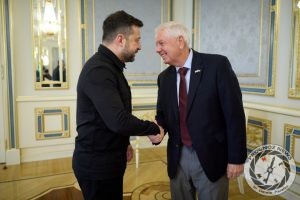
For Ukrainians, Graham became a familiar figure rather than an occasional visitor. He was seen walking Kyiv’s streets despite the continuing threat of Russian missile attacks. He met wounded soldiers, government ministers, volunteers and ordinary citizens whose lives had been transformed by war. Such visits carried symbolic importance. They communicated that influential figures in Washington remained personally invested in Ukraine’s survival even as international headlines moved elsewhere.
President Volodymyr Zelenskyy frequently expressed appreciation for Graham’s efforts, recognising that maintaining bipartisan support in Washington required constant political engagement. Graham became one of the bridges connecting Ukraine to influential circles within the Republican Party at moments when that connection appeared increasingly fragile.
His broader political career was, of course, considerably more complicated. Over three decades in Congress he evolved from a prominent ally of Senator John McCain into one of President Donald Trump’s closest confidants after initially being amongst his sharpest critics. That transformation attracted admiration from some quarters and criticism from others. Foreign policy hawks praised his consistency on national security while opponents questioned the apparent flexibility of his domestic political alliances.
Yet even critics generally acknowledged one striking exception to accusations of inconsistency: Ukraine. From the first days of Russia’s invasion until the final days of his life, Graham’s position scarcely altered. Regardless of shifts within American domestic politics, he continued to insist that abandoning Ukraine would represent a profound strategic mistake.
History often remembers politicians not for the thousands of votes they cast but for the causes they chose to champion when those causes became politically difficult. For Graham, Ukraine became such a cause. As enthusiasm waned in parts of Washington and funding debates grew increasingly contentious, he remained among the most visible Republican voices arguing that America’s credibility depended upon sustaining support.
His final journey to Kyiv now carries an added poignancy. It demonstrated that his commitment was not merely rhetorical. Even in the last days of his life he chose to spend time with a nation still under bombardment, reaffirming that America’s partnership with Ukraine required more than speeches delivered safely from Capitol Hill.
Ukraine has lost many foreign friends during this long war through retirement, electoral defeat and shifting political priorities. Lindsey Graham’s death removes one more influential advocate from an already narrowing circle. His successors may disagree over tactics, funding levels or diplomatic strategy, but they inherit a legacy of engagement that he worked tirelessly to preserve.
Whether one agreed with every aspect of Lindsey Graham’s politics is, in the end, beside the point. Democracies are not built upon unanimity but upon conviction. On the defining foreign policy question of his final years, Graham displayed a conviction that rarely faltered. He believed Ukraine deserved the means to defend herself, that Russian aggression had to be resisted and that democratic nations could not afford indifference.
In years to come, when historians examine why Ukraine endured through her greatest trial, they will rightly focus upon the courage of Ukrainian soldiers and civilians. Yet they will also remember those abroad who refused to allow the world to look away. Among that company, Senator Lindsey Graham will occupy a prominent place.
88 Views



Most Readings