The Caspian Front: Ukraine’s Expanding War Against Russian and Iranian Logistics
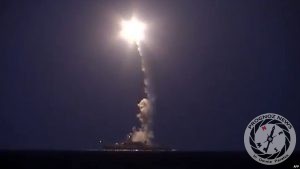
By Matthew Parish, Associate Editor
Tuesday 28 July 2026
Wars have a tendency to expand beyond the geographical boundaries that initially appear to define them. They spread not merely through armies crossing frontiers but through the inexorable logic of strategy. Every supply route becomes a potential battlefield, every commercial network a possible military asset and every supposedly secure rear area a theatre of operations waiting to be transformed. Recent Ukrainian strikes against Russian-flagged vessels in the Caspian Sea, reportedly carrying Iranian military cargoes, illustrate precisely this evolution. If confirmed in their reported scope, they represent not simply another successful long-range operation but a profound shift in the geography of the war.
For much of the conflict, Russia sought to portray the Caspian Sea as a sanctuary. Bounded by Russia, Kazakhstan, Turkmenistan, Iran and Azerbaijan, it lies far beyond the traditional reach of Ukrainian military power. Since the beginning of the full-scale invasion, Moscow has increasingly relied upon this inland sea as an artery through which strategic cargoes could move with relative security. Iranian drones, components, electronics and other military materiel have reportedly travelled northwards towards Russian ports before being distributed to factories and operational units supporting the war effort.
The strategic logic behind such routes has always been obvious. Maritime transport offers economies of scale that neither railways nor road convoys can match. Cargoes crossing the Caspian avoid many of the surveillance capabilities that exist in the Black Sea or eastern Mediterranean. They also bypass sanctions enforcement mechanisms that have become increasingly sophisticated elsewhere. What appears outwardly to be ordinary commercial shipping can, in practice, become an extension of a military supply chain.
Ukraine’s apparent decision to attack these vessels therefore reflects a broader evolution in modern warfare. Increasingly, the distinction between civilian logistics and military logistics has become difficult to sustain when commercial infrastructure is systematically integrated into a nation’s war effort. Railways transporting civilian freight by day carry tanks by night. Merchant vessels that once moved agricultural products may later transport missile components or drone engines. Ports become dual-use installations whose civilian appearance conceals military significance.
From Kyiv’s perspective, the strategic calculation is straightforward. Every Iranian drone component prevented from reaching Russia is one fewer weapon available for attacks upon Ukrainian cities. Every disruption imposed upon the Russia-Iran logistics partnership raises costs, creates uncertainty and forces Moscow to divert scarce resources towards protecting infrastructure that previously required little attention.
The significance extends beyond the physical destruction of individual ships. Maritime commerce depends fundamentally upon confidence. Shipowners require predictable insurance premiums. Crews require reasonable assurances of safety. Freight operators depend upon schedules that can be calculated months in advance. Once military operations intrude upon these assumptions, commercial efficiency deteriorates rapidly.
The psychological effects may ultimately outweigh the material losses. If Russian or Iranian shipping companies conclude that the Caspian Sea can no longer be regarded as a secure rear area, cargoes may require additional escorts, rerouting or protective measures. Insurance costs may increase. Loading schedules may become more cautious. The entire logistics chain slows, even when relatively few vessels are actually damaged.
The strikes also illuminate the remarkable transformation of Ukrainian military capability. At the outset of the invasion, few observers imagined that Ukraine would possess the capacity to conduct precision operations thousands of kilometres from the principal front lines. Yet necessity has driven innovation at extraordinary speed. Long-range drones, sophisticated intelligence fusion, satellite support and unconventional operational planning have enabled Kyiv to threaten targets once considered completely beyond its reach.
Equally significant is what these operations reveal about the growing strategic partnership between Moscow and Tehran. For several years the relationship was often characterised as transactional. Iran supplied drones. Russia provided diplomatic support, technology and political backing. Increasingly, however, the relationship appears to resemble a far more integrated military partnership, with logistics, intelligence and industrial cooperation becoming deeply intertwined. Ukrainian officials have further alleged that Russia has assisted Iran with intelligence relevant to regional military operations, underscoring Kyiv’s argument that the two theatres of conflict are no longer entirely separate.
That convergence inevitably broadens Ukraine’s conception of legitimate military targets. If Iranian industrial production materially sustains Russia’s campaign against Ukraine, then disrupting the transportation network connecting the two countries becomes strategically attractive. Whether such operations remain confined to maritime logistics or evolve further will depend upon both military capability and political calculation.
Naturally, these developments carry considerable diplomatic risks. Iran has strongly condemned the reported attacks, summoned Ukraine’s diplomatic representative and warned that such actions cannot pass without response. Tehran characterises the vessels as commercial shipping, whereas Kyiv maintains that they were carrying military cargo essential to Russia’s war effort. These competing narratives will undoubtedly form part of an increasingly complex debate concerning the application of international humanitarian law to dual-use maritime commerce.
The wider implications reach beyond Ukraine and Iran. Every state observing contemporary warfare must now reconsider long-held assumptions regarding strategic depth. Geography no longer guarantees security. Inland seas are no longer insulated from conflict simply because they lack direct access to the world’s oceans. Long-range unmanned systems have altered the mathematics of distance. Targets once protected by thousands of kilometres of territory may now find themselves within operational reach.
Military historians often identify particular moments when wars undergo qualitative transformation rather than simple quantitative escalation. The arrival of trench warfare in 1914, strategic bombing during the Second World War and precision-guided weapons in the late twentieth century all changed not merely how wars were fought but how strategists understood the battlefield itself.
The emergence of the Caspian Sea as an active theatre may represent another such moment. It suggests that the Russia-Ukraine war has matured into something far larger than a conventional territorial conflict. It has become an interconnected contest of industrial capacity, global supply chains, intelligence networks and technological innovation stretching across continents.
The essential lesson is one that future military planners will study carefully. In an era dominated by autonomous systems, satellite surveillance and precision strike capabilities, no logistics corridor can safely assume invisibility. Every mile travelled by cargo destined for the battlefield has become part of the battlefield itself.
75 Views



Most Readings