The Quiet Architects of Escalation: Chinese Technology, Russian Intelligence and Iran’s Expanding Reach
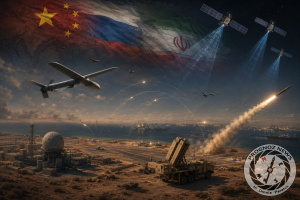
By Matthew Parish, Associate Editor
Tuesday 28 July 2026
Wars are often described in terms of those who pull the trigger. Yet the more consequential actors frequently remain several hundred or several thousand miles from the battlefield. They provide no divisions, deploy no fighter aircraft and formally declare themselves neutral. Instead they contribute satellite imagery, navigation systems, electronic components, intelligence analysis and operational experience. Modern conflict has increasingly become an exercise in enabling rather than directly fighting.
The growing effectiveness of Iranian missile and drone strikes against American installations across the Gulf region illustrates this transformation. While Iran has spent decades developing indigenous military industries under the pressure of sanctions, her recent improvements appear increasingly difficult to explain solely through domestic innovation. Public reporting and statements from Western officials have pointed towards expanding technological and intelligence assistance from both Russia and China, although the precise scope of that cooperation remains disputed and much of the underlying intelligence remains classified.
Russia’s contribution appears principally intellectual and informational rather than industrial. The Kremlin has accumulated extensive practical experience in conducting high-intensity missile and drone warfare throughout its invasion of Ukraine. That experience encompasses not merely the weapons themselves but the entire process of integrating reconnaissance, electronic warfare, satellite surveillance and precision targeting into a coherent operational system. Reports indicate that American intelligence agencies are investigating whether Russian services have supplied Iran with targeting information concerning United States military facilities and the movements of American naval and air assets operating throughout the Gulf. Although no definitive public conclusion has yet been announced, the investigations themselves illustrate the seriousness with which such possibilities are regarded in Washington.
Operational doctrine may prove even more valuable than raw intelligence. Russian forces have demonstrated in Ukraine that sophisticated air-defence systems can be overwhelmed not simply by larger numbers of missiles but through carefully choreographed combinations of inexpensive drones, decoys and precision-guided weapons. Iran appears increasingly to have adopted similar methods, using unmanned aerial vehicles to exhaust or distract defensive systems before more capable missiles approach their targets. Such adaptation represents the transfer not merely of technology but of military learning accumulated through years of combat.
China’s contribution occupies a different domain. Beijing possesses neither Russia’s recent combat experience nor its extensive intelligence relationships throughout the Middle East. Instead China excels in those enabling technologies that increasingly determine the effectiveness of modern precision warfare.
Satellite navigation is one example. Whereas earlier generations of Iranian missiles depended heavily upon relatively crude inertial guidance, newer systems reportedly integrate signals from China’s BeiDou navigation constellation alongside Russia’s GLONASS, providing greater resilience should GPS become degraded or denied. At the same time Chinese-produced electronics, microprocessors, sensors and dual-use components have become embedded throughout global supply chains, making their eventual appearance within Iranian weapons systems both plausible and difficult entirely to prevent.
More controversial are allegations concerning Chinese commercial satellite imagery. The United States has imposed sanctions upon Chinese companies accused of supplying imagery capable of supporting Iranian targeting operations. Whether such imagery has been provided knowingly as military assistance or indirectly through commercial channels remains a matter of continuing dispute. Nevertheless the distinction between civilian and military geospatial intelligence has become increasingly blurred. Commercial satellites now generate imagery whose quality rivals capabilities once monopolised by governments.
The convergence of Russian operational expertise with Chinese technological infrastructure creates something qualitatively different from either contribution alone. Russia understands how to conduct contemporary missile campaigns against sophisticated Western air defences because it has been fighting precisely such campaigns for years. China manufactures much of the technological ecosystem upon which precision warfare increasingly depends, from communications equipment to navigation infrastructure and advanced electronics. Iran supplies the strategic motivation, regional geography and indigenous manufacturing capacity required to translate those external advantages into operational capability.
None of this necessarily implies direct command and control from Moscow or Beijing. Indeed both governments appear determined to avoid becoming overt belligerents in any confrontation with the United States. Their preferred strategy has consistently been to remain below the threshold of direct military participation while nevertheless ensuring that American military power encounters increasing resistance wherever it is deployed. This approach enables both countries simultaneously to weaken American strategic influence and minimise their own exposure to escalation.
The implications extend well beyond the Middle East. Contemporary warfare increasingly resembles an ecosystem rather than a contest between isolated states. Intelligence collected by one country may guide weapons manufactured by another and launched by a third against forces belonging to a fourth. Military effectiveness consequently depends less upon national self-sufficiency than upon participation within resilient technological and intelligence networks.
For the United States and her allies this represents a profound strategic challenge. Deterring Iran alone becomes insufficient if Iranian capabilities derive substantially from expertise and technologies originating elsewhere. Air-defence systems must now defeat not merely Iranian missiles but innovations developed through Russian battlefield experience and Chinese industrial capacity. Countering such an ecosystem requires equally integrated cooperation among Western intelligence agencies, defence industries and allied governments.
Whether this emerging alignment ultimately evolves into a formal military bloc remains uncertain. Russia’s resources remain constrained by its continuing war against Ukraine, while China has consistently demonstrated caution whenever direct military confrontation with the United States becomes conceivable. Yet formal alliances are no longer the only measure of strategic cooperation. Shared technologies, intelligence exchanges and operational learning can produce military effects approaching those once associated exclusively with treaty obligations.
The battlefield therefore begins long before the missile leaves its launcher. It begins in satellite control centres, intelligence fusion cells, semiconductor fabrication plants and software laboratories. Those invisible networks increasingly determine which side sees first, decides first and strikes first. The Gulf may merely be the latest theatre in which that reality has become impossible to ignore.
68 Views



Most Readings