The Critique of Artificial Reason: What Kant Might Have Made of Artificial Intelligence
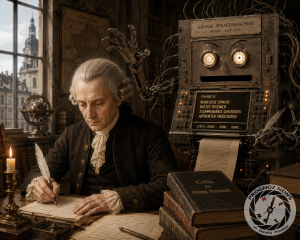
By Matthew Parish, Associate Editor
Thursday 30 July 2026
The greatest philosophical works do not merely answer the questions of their own age. They create frameworks capable of interrogating ages yet unborn. Few books exemplify this more than Immanuel Kant’s Critique of Pure Reason, published in 1781, a work whose ambition was nothing less than to determine the limits and conditions of human knowledge itself. More than two centuries later humanity finds itself confronting a phenomenon that Kant could scarcely have imagined in its technological form yet might have recognised immediately in its philosophical significance: machines that appear to reason.
Artificial intelligence has revived questions that many philosophers assumed had become settled. Can intelligence exist without consciousness? Can reasoning occur without understanding? Can a machine produce knowledge, or merely rearrange information? Above all, if intelligence becomes increasingly detached from biological minds, what becomes of Kant’s central project of explaining the architecture of reason?
Remarkably, Kant’s first Critique provides not only a vocabulary for approaching these questions but perhaps the most rigorous framework ever devised for resisting both technological utopianism and technological despair.
Kant’s revolution in philosophy was famously “Copernican”. Rather than assuming that our knowledge conforms to objects, he proposed that objects, as we experience them, conform to the structures of our minds. Human beings never encounter reality in its raw form. We encounter phenomena — appearances already organised by the innate forms of sensibility, namely space and time, together with the categories of understanding, including causation, substance, plurality and necessity.
This distinction between the phenomenal and the noumenal worlds lies at the heart of the first Critique. We know appearances. Things-in-themselves remain forever inaccessible.
Artificial intelligence presents a curious inversion of this doctrine.
Modern large language models are built upon extraordinary quantities of human language. They never perceive the world directly. They do not see objects as humans see them. They possess no sensory manifold comparable to ours. Instead they receive symbols that already embody countless generations of human conceptual organisation. They inherit language after the human mind has already performed the Kantian labour of structuring experience.
In a curious sense, artificial intelligence inhabits only the phenomenal world — not even the phenomenal world itself but humanity’s linguistic representation of it.
Kant might therefore observe that today’s artificial intelligence lacks precisely the faculty upon which genuine understanding depends: intuition.
For Kant, concepts without intuitions are empty. Intuitions without concepts are blind.
Large language models possess concepts in abundance. They manipulate extraordinarily rich symbolic structures. Yet they possess no original intuitions corresponding to those concepts. They have no immediate encounter with space, time, colour, sound, pain, gravity, hunger, mortality or love. They know these only through human descriptions.
One might therefore argue that artificial intelligence exemplifies precisely the condition Kant warned against — concepts divorced from intuition.
This observation explains both the astonishing successes and the persistent failures of modern AI.
The systems excel wherever conceptual relationships dominate. Mathematics, legal reasoning, programming, translation and scientific summarisation depend heavily upon symbolic coherence. Here artificial intelligence often performs spectacularly.
Yet the same systems continue occasionally to produce absurdities.
They hallucinate.
They confuse context.
They misunderstand physical impossibilities.
They occasionally fail at tasks that young children perform effortlessly.
From a Kantian perspective these are not merely engineering defects. They reveal an architecture lacking the synthetic unity between intuition and understanding that defines human cognition.
Even more intriguing is Kant’s analysis of the transcendental unity of apperception — the famous “I think” that must be capable of accompanying all representations.
For Kant this unity does not merely describe consciousness. It constitutes the very possibility of coherent experience. Every perception belongs to one unified subject capable of recognising itself across time.
Here contemporary artificial intelligence appears to diverge sharply from human minds.
A language model generates responses without possessing a stable self in the Kantian sense. It has no enduring first-person perspective extending continuously through experience. Each interaction reconstructs context anew. Its apparent personality emerges statistically rather than autobiographically.
This distinction is often obscured because language naturally encourages anthropomorphism. Human beings instinctively attribute agency wherever coherent conversation appears.
Kant, however, was deeply suspicious of confusing appearances with underlying reality.
The appearance of coherent dialogue would never have persuaded him that genuine subjectivity had emerged.
Indeed he might regard the illusion of personality as another example of transcendental illusion — reason mistaking the limits of its own concepts.
Yet Kant would almost certainly resist the opposite error as well.
He would reject simplistic dismissals claiming artificial intelligence merely imitates thought.
The first Critique repeatedly demonstrates that reason itself consists in the application of formal rules.
Logic does not depend upon biology.
Inference does not depend upon carbon.
The categories themselves describe structures rather than physical substances.
Nothing within Kant’s account logically requires that every possible rational system must be biologically instantiated.
Indeed, Kant consistently separates empirical psychology from transcendental philosophy. His concern is not how brains happen to function but what conditions make knowledge possible.
This distinction becomes increasingly significant as artificial intelligence develops.
If future systems acquire genuine perception through robotics, autonomous exploration and continuous interaction with the physical world, then they begin to approach something resembling Kantian intuition.
If those perceptions become unified within a stable cognitive architecture possessing continuous self-reference, then further Kantian objections begin to weaken.
Whether such developments ultimately produce consciousness remains an entirely separate question.
Kant would almost certainly insist that consciousness cannot simply be inferred from behaviour.
The first Critique repeatedly warns against extending concepts beyond the evidence that legitimately supports them.
Neither optimistic declarations that machines are already conscious nor confident assertions that they never could be would satisfy his standards of philosophical argument.
Both exceed what experience presently justifies.
Perhaps Kant’s greatest contribution to the contemporary debate lies not in determining whether machines think but in reminding humanity to ask a prior question: what exactly do we mean by thinking?
The first Critique is fundamentally a work of intellectual humility.
It teaches that reason becomes most dangerous precisely when it forgets its own limits.
Modern discussions of artificial intelligence often oscillate between two equally extravagant metaphysical positions. Some proclaim the imminent birth of machine consciousness. Others insist that no machine could ever possess genuine understanding regardless of future technological development.
Both positions display a confidence that Kant would likely regard with suspicion.
The wiser course is transcendental modesty.
Artificial intelligence undoubtedly performs many operations traditionally associated with intelligence. It reasons, translates, summarises, predicts and increasingly assists scientific discovery. These achievements are real.
Whether they constitute understanding remains an open question.
Whether understanding requires consciousness remains another.
Whether consciousness itself can ever be recognised objectively remains perhaps the deepest mystery of all.
Kant would remind us that philosophy advances not by abolishing mystery but by distinguishing genuine mysteries from conceptual confusions.
Artificial intelligence has not rendered the first Critique obsolete.
Quite the contrary.
As machines increasingly perform acts once believed uniquely human, Kant’s investigation into the foundations of knowledge becomes more relevant than ever. Before deciding whether machines possess minds, we must first understand what a mind is. Before asking whether artificial intelligence can know reality, we must understand what knowledge itself requires.
The first Critique was written to establish the boundaries of reason.
Artificial intelligence now compels us to redraw those boundaries with greater precision than at any time since Kant first set pen to paper.
In that sense the eighteenth-century philosopher remains an indispensable guide to one of the twenty-first century’s defining questions. His enduring lesson is neither optimism nor pessimism but disciplined enquiry — the insistence that every astonishing technological advance should first be subjected to an even more astonishing exercise of philosophical scrutiny.
166 Views



Most Readings