The Critique of Artificial Morality: What Kant’s Second Critique Can Teach Us About Artificial Intelligence
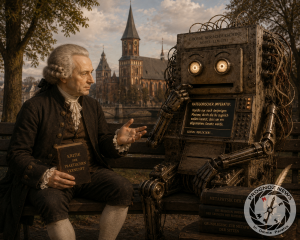
By Matthew Parish, Associate Editor
Friday 31 July 2026
If Immanuel Kant’s Critique of Pure Reason asks what we can know, its successor, the Critique of Practical Reason, asks a still more demanding question: what ought we to do? It is one thing to possess intelligence. It is quite another to possess a moral will. As artificial intelligence becomes ever more capable of performing tasks once thought to require human judgment, this distinction is assuming profound practical significance. Machines increasingly diagnose illnesses, recommend prison sentences, determine eligibility for loans, identify military targets and draft legislation. They participate, directly or indirectly, in decisions with immense moral consequences. Yet does participation in moral decision-making amount to morality itself?
Kant would almost certainly have answered in the negative.
For Kant, morality is not measured by outcomes alone. Nor is it simply adherence to externally imposed rules. The moral worth of an action depends upon the maxim from which it is performed. A person acts morally only when acting from duty, recognising through reason the binding force of the moral law. One does not become virtuous by accidentally producing good consequences, nor by following instructions out of fear, habit or self-interest. One becomes virtuous by freely willing to do what reason recognises as universally right.
This distinction immediately creates a formidable obstacle for contemporary artificial intelligence.
An AI system may comply perfectly with every ethical rule programmed into it. It may exhibit impeccable consistency. It may avoid prejudice more successfully than many human beings. It may calculate consequences with extraordinary precision. Nevertheless, from a Kantian perspective, none of this demonstrates morality.
It demonstrates obedience.
Kant regarded obedience and morality as fundamentally different phenomena.
The soldier who obeys because he fears punishment differs morally from the citizen who obeys because he recognises justice. Two individuals may perform precisely the same outward act while differing completely in moral worth because their motivations differ.
Artificial intelligence, as presently constituted, has no motivations in this sense at all.
It has objectives.
It has optimisation functions.
It has constraints.
It has probabilities.
But it does not experience duty.
The distinction is subtle but decisive.
Suppose an autonomous vehicle swerves to avoid striking a pedestrian. Modern observers naturally describe this as an ethical decision. Yet the vehicle has not recognised the intrinsic dignity of the pedestrian. It has not reflected upon universal principles governing human life. It has simply executed algorithms designed by engineers attempting to approximate ethical behaviour.
Its conduct may be admirable.
Its morality, for Kant, remains absent.
The heart of Kant’s practical philosophy is the concept of autonomy. Human beings are morally significant because they legislate the moral law for themselves through reason. Freedom does not consist in doing whatever one wishes. Rather, it consists in voluntarily binding oneself to universal principles that every rational being could endorse.
This is the famous categorical imperative.
Act only according to that maxim whereby you can at the same time will that it should become a universal law.
Artificial intelligence raises an intriguing possibility here. One could imagine programming such a principle into a sufficiently advanced machine. Indeed, researchers in machine ethics have attempted to formalise variants of Kantian reasoning for autonomous systems.
Yet formalising the rule is not equivalent to possessing the autonomy that gives the rule moral significance.
Kant’s moral philosophy is not merely procedural. It is existential.
The moral law has authority because rational beings freely recognise themselves as subject to it. That recognition cannot simply be installed like software. It must arise from the very structure of rational agency itself.
This explains another of Kant’s most celebrated formulations of the categorical imperative: always treat humanity, whether in yourself or another, never merely as a means but always at the same time as an end.
Here artificial intelligence presents an irony that Kant would likely find deeply instructive.
The more capable AI systems become, the greater the temptation for human beings to treat one another instrumentally.
Employers may judge workers solely against algorithmic productivity metrics.
Governments may increasingly delegate political accountability to automated systems.
Consumers may prefer endlessly accommodating digital companions to imperfect human relationships.
Institutions may optimise efficiency while neglecting compassion.
In each case the danger lies not in machines becoming immoral, but in humans forgetting their own moral obligations.
Kant consistently insisted that persons possess dignity rather than price. Objects have market value. Persons possess intrinsic worth because they are rational ends in themselves.
Artificial intelligence, however sophisticated, risks encouraging societies to evaluate human beings as measurable components within larger systems of optimisation. Efficiency, prediction and automation become the supreme virtues while dignity quietly recedes from view.
Paradoxically, therefore, the principal ethical challenge of artificial intelligence may concern not machine morality but human morality.
The Second Critique would urge us to ask whether reliance upon increasingly capable machines strengthens or weakens our own capacity for moral judgment.
Do physicians become less morally attentive if diagnostic responsibility shifts to algorithms?
Do judges become less accountable if sentencing recommendations emerge from statistical models?
Do military commanders become less conscious of human responsibility if autonomous weapons increasingly determine tactical engagements?
These questions cannot be answered through engineering alone.
They concern character.
They concern responsibility.
Above all, they concern freedom.
Kant believed that every moral decision ultimately presupposes freedom, even though freedom cannot itself be demonstrated scientifically. We experience ourselves as obligated, and obligation presupposes that we could have acted otherwise.
Artificial intelligence possesses no comparable experience.
Its outputs arise through computation governed by architecture, training and inputs. Whether future systems might eventually develop forms of agency resembling human freedom remains speculative. Even if they did, demonstrating such freedom would prove extraordinarily difficult.
Indeed, Kant would probably argue that it is impossible to establish empirically.
Freedom belongs to practical reason rather than theoretical observation.
Consequently, declarations that artificial intelligence has become morally responsible would require philosophical arguments far deeper than demonstrations of impressive behaviour.
One of the enduring strengths of Kant’s moral philosophy is its resistance to appearances.
An eloquent speech does not establish virtue.
A compassionate expression does not establish benevolence.
An intelligent conversation does not establish moral agency.
Only the free exercise of reason in accordance with duty possesses genuine moral worth.
This insight has acquired renewed importance in an era when artificial systems increasingly imitate empathy with remarkable fluency.
A conversational agent may apologise.
It may express sympathy.
It may reassure.
It may even persuade users that it cares.
Yet Kant would remind us that moral emotions derive their significance from the rational will standing behind them.
Without that will, they remain representations rather than experiences.
This is not to diminish the extraordinary usefulness of artificial intelligence. On the contrary, Kant would likely admire technologies that extend human capacities while respecting human dignity. Machines that relieve suffering, expand education, improve medicine and reduce drudgery serve profoundly worthwhile ends.
But they remain instruments.
The moral agent remains the human being who chooses how those instruments are designed, deployed and governed.
Perhaps the deepest lesson of the Critique of Practical Reason for the age of artificial intelligence is therefore unexpectedly reassuring.
Human uniqueness does not ultimately depend upon outperforming machines in calculation, memory or even certain forms of reasoning. Those contests may already be passing beyond us.
Rather, our distinctiveness lies in the capacity to recognise duty, to bind ourselves freely to principles that transcend immediate advantage and to acknowledge the irreducible dignity of every rational person.
Artificial intelligence may become wiser in many respects.
It may become more knowledgeable.
It may become more reliable.
It may even become more prudent.
Whether it can ever become good, in the specifically Kantian sense of acting from duty under the self-imposed authority of the moral law, remains an entirely different question.
Until that question is answered, the greatest ethical responsibility surrounding artificial intelligence rests not with the machines we create, but with the people who create them.
Kant would almost certainly have insisted that this responsibility cannot be delegated. Moral agency, unlike computational power, cannot simply be outsourced. Every technological revolution ultimately returns us to the same ancient question that animated the Second Critique from its opening pages: not what our inventions can do, but what we ought to do with them.
122 Views



Most Readings