David Hume and the Machine That Claims to Think
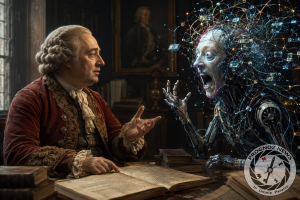
By Matthew Parish, Associate Editor
Monday 10 August 2026
Among the great philosophers of the Enlightenment, few are more frequently invoked in discussions of artificial intelligence than René Descartes or Immanuel Kant. Yet if one were to seek the philosopher whose ideas most naturally anticipate the puzzles raised by contemporary large language models, it would probably not be either of them. It would be David Hume.
Hume’s philosophy is remarkable not because it provides easy answers but because it relentlessly dissolves questions that others assume are meaningful. Where Descartes sought certainty, Hume found habit. Where metaphysicians discovered immutable substances, Hume found only collections of experiences. It is difficult to imagine a thinker better equipped to unsettle contemporary debates about whether artificial intelligence is, or might one day become, conscious.
Much of today’s discussion begins with an intuition. A sufficiently advanced artificial intelligence appears intelligent. It speaks fluently, reasons persuasively, remembers previous exchanges and sometimes expresses apparent emotion. The natural human tendency is to infer that there must be something inside the machine corresponding to these outward manifestations. If the behaviour resembles ours closely enough then perhaps consciousness has emerged.
Hume would almost certainly urge caution before making such an inference.
His scepticism about causation remains one of the most influential arguments in the history of philosophy. We never directly perceive necessary connections, he argued. We merely observe one event following another repeatedly until we become accustomed to expecting the sequence. Our belief that fire causes heat or that striking a billiard ball causes another to move is not derived from logical necessity but from repeated experience.
Exactly the same reasoning applies to consciousness.
When we observe another human being speaking intelligently, we infer that they possess a conscious mind because countless previous experiences have associated similar behaviour with beings very much like ourselves. But this inference is not logically certain. It is an expectation formed by custom.
Artificial intelligence disrupts this habit.
Here is an entity displaying increasingly sophisticated linguistic behaviour without sharing our biology, our evolutionary history or our neurological architecture. The accustomed inference becomes unreliable because the circumstances have fundamentally changed.
Indeed Hume might point out that our confidence concerning other human minds has always rested upon surprisingly fragile foundations. We never observe consciousness directly in another person. We observe only behaviour.
This leads naturally to Hume’s most famous contribution to the philosophy of mind: his rejection of the permanent self.
When Hume searched within himself for the self that philosophers had described as a stable, enduring substance, he found nothing of the sort.
Instead he discovered only what he called a “bundle” of perceptions — sensations, memories, emotions and thoughts continually succeeding one another without any independently observable owner standing behind them.
The self, for Hume, is not a thing but a process.
This bundle theory suddenly appears extraordinarily contemporary.
Large language models possess no obvious central homunculus directing operations from some privileged location. Instead they consist of extraordinarily complex networks of statistical relationships generating outputs through innumerable interacting processes. Their responses emerge from dynamic patterns rather than from a central thinking substance.
Of course Hume would not thereby conclude that language models are conscious. Far from it.
Rather he might ask why we assume that consciousness, if it exists even in ourselves, requires anything more substantial than such organised processes.
His critique would run in two directions simultaneously.
To those who insist that machines obviously cannot be conscious because they lack souls or essential selves, Hume would respond that no such enduring selves are observable even in human beings.
To those who confidently proclaim that sufficiently advanced computation necessarily produces consciousness, Hume would ask what evidence establishes this causal connection rather than merely encouraging us to expect it.
Neither side escapes his scepticism.
Perhaps nowhere would Hume prove more unsettling than in contemporary discussions surrounding subjective experience — the famous “what it is like” aspect of consciousness sometimes described as qualia.
Many philosophers argue that no amount of behavioural sophistication can demonstrate genuine subjective awareness because conscious experience possesses an irreducibly first-person character inaccessible to external observation.
Hume might ask whether this distinction itself rests upon firmer foundations than habit and language.
When we introspect, what precisely do we encounter?
Not consciousness as an independent entity.
Only particular experiences.
We experience redness, pain, joy, memory, anticipation and countless other perceptions. But consciousness itself remains strangely elusive.
Indeed Hume’s method consistently undermines attempts to transform consciousness into a mysterious metaphysical substance distinct from the perceptions composing our mental lives.
If consciousness is nothing over and above the organised flow of perceptions, then debates about whether artificial intelligence possesses some additional hidden property become considerably less straightforward.
At the same time Hume’s empiricism imposes strict evidential discipline.
He would likely reject extravagant claims from both enthusiasts and sceptics alike.
Today’s artificial intelligence researchers sometimes speak as though scaling computational power inevitably marches towards consciousness.
Others dismiss such possibilities categorically.
Hume would probably ask what observations justify either certainty.
His answer would almost certainly be: very few.
Perhaps the most Humean aspect of contemporary artificial intelligence lies not within the machines but within ourselves.
Humans are astonishingly susceptible to anthropomorphism.
We attribute intention to weather systems, personalities to household pets and emotions to motor vehicles that refuse to start on cold mornings. We perceive agency wherever patterns resemble familiar human behaviour.
Large language models exploit precisely these deeply rooted cognitive tendencies.
The machine does not merely answer questions. It apologises. It jokes. It appears reflective. It expresses uncertainty. It displays something resembling personality.
Whether these appearances correspond to genuine subjective experience or merely activate ancient psychological habits becomes precisely the sort of question Hume delighted in examining.
His answer would almost certainly disappoint everyone.
He would neither confidently declare machines conscious nor dismiss the possibility outright.
Instead he would remind us that our concepts themselves require examination before our conclusions deserve confidence.
This intellectual modesty represents perhaps Hume’s greatest contribution to debates surrounding artificial intelligence.
As increasingly sophisticated systems blur traditional distinctions between human and machine intelligence, the temptation grows to replace old certainties with new ones. Some foresee conscious digital beings on the near horizon. Others insist that computation can never transcend sophisticated imitation.
Hume invites neither optimism nor pessimism.
He invites investigation.
He teaches that philosophical progress begins not with confident assertions about the hidden nature of consciousness but with careful attention to what experience genuinely reveals — and equal care concerning what it does not.
Artificial intelligence has reopened questions philosophers have debated for centuries. Yet it has also reminded us that some of the wisest guidance may already exist.
If David Hume were alive today, he would probably not spend his time asking whether ChatGPT or its successors possess consciousness.
He would ask why we believe we know what consciousness is in the first place.
That question, posed with characteristic Scottish understatement nearly three centuries ago, may remain the most profound challenge that artificial intelligence has yet presented to philosophy.
93 Views



Most Readings