Putin in the Kurils: An Old Territorial Dispute in a New Asian Cold War
By Matthew Parish, Associate Editor
Friday 14 August 2026
There are few places in the world where the unfinished business of the Second World War remains quite so literal as it does among the cold, volcanic islands lying between the Russian Kamchatka Peninsula and the Japanese island of Hokkaido. Russia and Japan have never concluded a formal peace treaty ending their wartime hostilities. At the centre of the dispute are four islands at the southern end of the Kuril chain — Iturup, Kunashir, Shikotan and the Habomai islets — occupied by Soviet forces in 1945, administered by Moscow ever since and claimed by Japan as its Northern Territories.
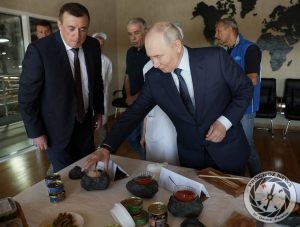
On 13 August 2026 Vladimir Putin travelled to Iturup — Etorofu in Japanese — in his first visit as Russian President to the disputed islands. He inspected a fish-processing plant, a hospital and a school, while Japan summoned the Russian ambassador and Prime Minister Sanae Takaichi described the visit as “absolutely unacceptable”. The journey followed Putin’s visit to nearby Sakhalin, where Russian naval exercises were under way.
On the surface this might appear to be another piece of Putinist political theatre — the Russian President travelling to a remote extremity of the Federation, inspecting public works and reminding television viewers that Moscow’s writ extends across eleven time zones.
It is considerably more important than that.
Putin has governed Russia, directly or indirectly, for more than a quarter of a century without previously finding it necessary to visit the disputed Kurils. Dmitry Medvedev became the first Russian President to do so in 2010. That Putin should choose August 2026 to make the journey therefore deserves attention. It amounts to a geopolitical declaration: Russia’s European war and the emerging confrontation in East Asia are becoming parts of the same strategic system.
The last territorial settlement of 1945
The historical argument is complicated because both sides appeal to different parts of the diplomatic settlement surrounding the Second World War.
The Soviet Union entered the war against Japan in August 1945 and Soviet forces occupied the Kuril chain during the closing days of the conflict. Japanese inhabitants of the disputed islands were subsequently displaced and Soviet settlement followed. Moscow regards the resulting frontier as part of the legitimate territorial consequences of victory in 1945. Tokyo rejects that interpretation as applied to the four southern islands, maintaining that they are historically Japanese territories distinct from the Kuril Islands surrendered by Japan after the war.
Hence the peculiar situation in which two of the world’s major powers remain technically without a bilateral peace treaty more than eighty years after the fighting ended.
For decades there appeared at least some possibility that this historical anomaly might eventually be resolved. Shinzo Abe invested substantial political capital in cultivating Putin. There were proposals for joint economic development and recurring speculation that some version of the Soviet-Japanese Joint Declaration of 1956 — under which Moscow had contemplated transferring Shikotan and the Habomai group after conclusion of a peace treaty — might provide the basis for compromise.
Those hopes now look extraordinarily remote.
Russia’s full-scale invasion of Ukraine transformed Japanese policy towards Moscow. Japan joined the sanctions regime, supported Ukraine politically and financially and increasingly described Russia as part of her own security problem rather than merely as an awkward neighbour with which an old territorial quarrel remained unresolved. Moscow retaliated by abandoning peace-treaty negotiations.
Putin’s arrival on Iturup therefore resembles a ceremonial burial of the Abe strategy.
The message is that Russia no longer considers territorial compromise with Japan a useful instrument of statecraft.
Why the islands matter
The Kurils are sometimes described as though they were merely a collection of bleak rocks whose significance derives from national pride. This seriously understates their military importance.
The archipelago forms a geographical barrier between the Pacific Ocean and the Sea of Okhotsk. The latter is exceptionally important to Russian nuclear strategy because it provides operating areas for Russia’s Pacific Fleet ballistic-missile submarines. During the Cold War the Soviet Union increasingly treated the Sea of Okhotsk as a protected maritime bastion from which submarines carrying nuclear weapons could operate behind layers of naval, aerial and land-based defences.
Control of the Kuril chain assists in controlling the entrances to that bastion.
Iturup itself possesses airfields and substantial military infrastructure. Russia has strengthened her forces across the islands over recent years and the archipelago can support surveillance, air defence and anti-ship capabilities. Contemporary reporting on Putin’s visit accordingly emphasised that the islands have retained substantial strategic importance since the Cold War and that Moscow has progressively reinforced them.
Geography explains why.
Hokkaido lies immediately to the south-west. Japan is a treaty ally of the United States. American forces maintain major bases throughout the Japanese archipelago. In any serious confrontation between Russia and the United States in the Pacific, the Kurils would sit beside the routes through which Russian naval forces would seek access to the wider ocean — and beside the approaches through which hostile forces might attempt to penetrate the Sea of Okhotsk.
The islands are therefore simultaneously territory, fortress and gateway.
This makes their symbolic value unusually difficult to separate from their military importance.
The Ukraine connection
The most revealing feature of Putin’s journey may nevertheless be its connection with a war being fought thousands of kilometres away.
Japan has become one of Ukraine’s most consequential supporters outside Europe and North America. Tokyo’s position matters not principally because Japan is about to become a combatant in the European war — she is not — but because Japan demonstrates the increasingly artificial character of the distinction between European and Indo-Pacific security.
Russia has noticed this.
Putin used his visit to criticise Japanese sanctions and Japanese security policy. Contemporary accounts also placed the journey against the background of Japan’s closer military relationship with the United States and its increasingly explicit identification of Russia as a security threat.
The logic is familiar from Russian behaviour elsewhere. Moscow seeks to demonstrate that imposing costs upon Russia entails costs of its own.
Japan supports Ukraine. Russia can therefore make Japan uncomfortable in the North Pacific.
The asymmetry is important. Tokyo can impose sanctions, provide financial assistance to Kyiv and contribute to the diplomatic isolation of Moscow. Russia can deploy military forces within sight of Japanese territory, conduct naval exercises around Sakhalin and the Kurils and make conspicuous presidential visits to islands Japan claims as its own.
This is coercive signalling rather than preparation for war with Japan.
But coercive signalling is one of the Kremlin’s preferred diplomatic languages.
Russia turns east
There is also a broader transformation taking place.
For much of the post-Soviet era Russia imagined herself principally as a European great power possessing enormous Asian territories. Her commercial relationships, elite culture, financial connections and strategic arguments were overwhelmingly European. Even disputes with NATO were arguments about the European security order.
The Ukraine war has accelerated Russia’s transformation into something different — a Eurasian power whose political and economic centre of gravity is being pushed eastwards.
China is now indispensable to the Russian economy. North Korea has become an increasingly important strategic and military partner. Russian-Chinese military activity around Japan has acquired growing significance and Tokyo’s defence establishment increasingly assesses Russia, China and North Korea not as wholly separate security problems but as interacting ones. Japan’s recent defence assessments have emphasised precisely this deteriorating regional environment and the increasing coordination among the three powers.
This does not mean that Moscow, Beijing and Pyongyang constitute an Asian NATO. They do not. Their interests differ profoundly and China in particular has reasons to avoid becoming hostage to Russian adventurism.
But alliances do not have to be formal to alter strategic calculations.
Russia can pressure Japan from the north. China can pressure her around the Senkaku/Diaoyu Islands and Taiwan. North Korea can threaten her with ballistic missiles. Each country’s actions compel Tokyo to devote greater resources to defence and strengthen the argument inside Japan for closer military integration with the United States.
The paradox is that Russian pressure therefore produces precisely the strategic development Moscow says it opposes.
The Chinese complication
The Kuril dispute also creates an intriguing problem for China.
Beijing has generally benefited enormously from Moscow’s post-2022 estrangement from the West. Russia has become economically more dependent upon China while providing Beijing with discounted energy, diplomatic partnership and a strategically useful distraction for the United States and her allies.
Russia’s confrontation with Japan fits comfortably within that pattern.
Both Moscow and Beijing have increasingly invoked the settlement of the Second World War as a source of contemporary territorial legitimacy. Russia describes its possession of the Kurils as one of the irreversible results of victory in 1945. China similarly places enormous political emphasis upon the defeat of Japanese militarism and the post-war order.
That historical vocabulary is useful because it allows both governments to depict contemporary Japanese rearmament as something sinister — notwithstanding that Japan today is a democratic state whose military posture developed overwhelmingly within an American alliance structure.
Yet China must also be careful.
If territorial arrangements are permanently sanctified merely because they resulted from military victory, Beijing creates arguments that can operate inconveniently elsewhere. East Asian history is filled with changing frontiers, unequal treaties and competing historical claims. The region offers no shortage of governments capable of finding a nineteenth- or twentieth-century map supporting whatever territorial proposition they happen to prefer.
The Kremlin’s favourite principle — that history confers sovereignty wherever Russian soldiers happened to finish a war — is not a particularly stable foundation for an international order.
Japan changes
The greatest long-term consequence may therefore be found not in Moscow but in Tokyo.
Post-war Japan constructed one of history’s most remarkable political identities around military restraint. Article 9 of the Japanese Constitution renounced war and successive governments maintained defence expenditure and military capabilities within unusually restrictive political conventions.
That settlement has been changing.
China’s military expansion, North Korea’s nuclear programme and Russia’s invasion of Ukraine have all strengthened the Japanese argument that economic power without commensurate military capacity has become dangerous. Tokyo has been increasing defence expenditure, acquiring longer-range strike capabilities and deepening operational cooperation with Washington.
Putin’s visit to Iturup supplies another photograph for those making that argument.
This is why seemingly symbolic provocations can have strategic consequences. A Russian President standing on disputed territory does not alter the legal position of the islands. Russia controlled Iturup the day before Putin arrived and controlled it the day afterwards. But politics operates through perceptions as well as maps.
Every Russian military exercise near Japan, every North Korean missile launch and every Chinese demonstration around Taiwan contributes incrementally to the normalisation of Japanese military power.
Russia may eventually discover that humiliating Japan over four islands has helped create a considerably more formidable Japan.
A message for Washington
There is an American audience as well.
Washington is trying simultaneously to manage Russian aggression in Europe and Chinese power in the Pacific. Moscow has an obvious interest in making those theatres inseparable because American strategic resources are finite.
The more forces the United States must devote to defending Japan, monitoring the North Pacific and maintaining deterrence around the Korean Peninsula, the more complicated her global military planning becomes.
China benefits from analogous pressures in Europe. Russia benefits from Chinese pressure in the Pacific.
This is one reason the Ukraine war cannot sensibly be understood as an isolated European territorial dispute. It has become embedded within a wider contest over the international distribution of military power.
Ukraine, Japan, Taiwan and the Korean Peninsula are not interchangeable problems. Their histories and legal circumstances are radically different.
But the military resources of the United States and its allies that deter aggression in these places belong to the same finite pool.
Moscow understands this perfectly.
The Putin method
Finally there is something characteristically Putinist about the journey itself.
Putin’s foreign policy has always placed unusual emphasis upon possession demonstrated through physical presence. Russian leaders travel to disputed territories, build infrastructure upon them, station soldiers there and then insist that sovereignty is demonstrated by the mundane routines of administration.
Hence the symbolism of visiting not merely military installations but a school, hospital and fish-processing plant.
The message is deliberately banal: people live here, children study here, patients are treated here and fish are processed here. Therefore this is Russia.
It is the politics of faits accomplis translated into municipal administration.
The same political technique has been applied with infinitely greater violence in occupied Ukrainian territories. Once territory is seized, Moscow moves rapidly to transform a military occupation into an administrative fact — Russian passports, Russian schools, Russian officials, Russian infrastructure and eventually Russian constitutional claims.
The circumstances of the Kurils and occupied Ukraine are historically and legally different and should not simply be conflated. Yet the political instinct is recognisable.
Control is converted into administration; administration is converted into normality; normality is presented as sovereignty.
Islands at the edge of a larger confrontation
There is little reason to imagine that Putin’s visit heralds an imminent Russian-Japanese war. Neither government has an interest in such a catastrophe and Japan is not preparing to recover the Northern Territories by force.
That is precisely why the visit is interesting.
It belongs to the grey territory between peace and war in which much contemporary geopolitics now occurs — military exercises, sanctions, territorial visits, economic restrictions, diplomatic protests and strategic partnerships, each intended to alter another state’s calculations without crossing the threshold into open conflict.
Putin went to Iturup because he could.
Japan protested because she had to.
Neither action changes the frontier.
But the geopolitical environment surrounding that frontier has changed profoundly.
The old Kuril dispute once seemed an eccentric remnant of 1945 that might eventually be settled through patient diplomacy. Today it is becoming incorporated into something much larger — a tightening strategic confrontation connecting Russia, China and North Korea on one side with Japan, the United States and their increasingly interconnected partners on the other.
Ukraine sits unexpectedly but unmistakably inside this equation. Japan’s response to the Russian invasion helped destroy what remained of Moscow-Tokyo rapprochement. Russia’s response has been to remind Japan that Russia is not merely a European adversary. It is also Japan’s enormous northern neighbour.
Putin’s journey to a windswept island beside Hokkaido was therefore about considerably more than fish, hospitals or disputed maps.
It was a small ceremony marking the arrival of a new geopolitical age — one in which the unfinished wars of the twentieth century are being recruited into the strategic rivalries of the twenty-first.
93 Views



Most Readings