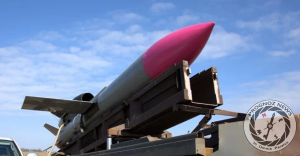
The Fire Point Ukrainian ballistic missile
By Matthew Parish, Associate Editor
Friday 5 June 2026
The recent emergence of Fire Point as one of Ukraine’s most ambitious defence manufacturers reflects a broader transformation in the country’s wartime economy. Three years ago, few outside specialist military circles had heard of the company. Today it stands amongst a new generation of Ukrainian defence enterprises attempting to do something that many observers considered impossible at the beginning of the full-scale Russian invasion in 2022: design and manufacture advanced missile systems almost entirely within Ukraine itself. At the centre of that effort lies the FP-7 ballistic missile programme, the first step in what Fire Point hopes will become a family of indigenous Ukrainian ballistic weapons.
The story of Fire Point is, in many respects, the story of Ukraine’s wartime industrial renaissance. As Western military aid became increasingly uncertain and Russia intensified attacks against Ukrainian cities, energy infrastructure and military facilities, Ukrainian planners came to recognise that imported weapons alone could never provide a complete solution. Foreign systems were expensive, politically constrained and dependent upon production decisions made thousands of kilometres away. The only sustainable answer was to rebuild a domestic defence industry capable of designing, testing and manufacturing increasingly sophisticated weapons at home.
Fire Point initially became known for long-range strike drones and later for the FP-5 Flamingo cruise missile. The company expanded with extraordinary speed, developing expertise in propulsion systems, guidance technologies, composite materials and warhead integration. Those capabilities provided the industrial foundation necessary for a far more difficult undertaking: ballistic missiles.
Unlike cruise missiles, which fly through the atmosphere using aerodynamic lift and powered engines throughout much of their flight, ballistic missiles follow a trajectory that carries them high above the atmosphere before descending towards their targets at enormous speed. This makes them particularly difficult to intercept. Even modern air defence systems can struggle against fast-descending ballistic targets because defenders have only seconds in which to detect, track and engage them. The ability to manufacture such weapons therefore represents a significant technological milestone for any country’s defence industry.
Fire Point unveiled its FP-7 and FP-9 missile concepts during 2025. The FP-7 was presented as a tactical ballistic missile intended for operational battlefield strikes. According to company statements, the missile has a range of approximately 200 kilometres, reaches speeds of around 1,500 metres per second and carries a warhead weighing roughly 150 kilograms. Fire Point claims an accuracy measured in metres rather than hundreds of metres, placing it within the category of modern precision-guided ballistic weapons.
More ambitious still is the FP-9. Although details remain limited and independent verification is difficult, Fire Point has suggested that the missile could eventually achieve ranges exceeding 800 kilometres whilst carrying a substantially larger payload. If such performance figures are realised in operational service, the system would provide Ukraine with a domestically produced deep-strike capability reaching far beyond the front lines.
What makes the Fire Point programme particularly noteworthy is not simply the missiles themselves but the degree of domestic industrial integration reportedly achieved. Company representatives have repeatedly emphasised that most components are produced within Ukraine. Composite structures, solid-fuel propulsion systems, electronics integration and guidance technologies are increasingly being sourced domestically. Such self-sufficiency reduces vulnerability to foreign export controls and supply-chain disruptions whilst ensuring that production can continue even during periods of political uncertainty amongst Ukraine’s allies.
The significance of this achievement becomes clearer when viewed against the historical background of Ukrainian missile development. During the Soviet period, Ukraine hosted some of the most advanced missile design bureaux in the USSR. Facilities in Dnipro designed strategic rockets that formed part of the Soviet nuclear arsenal. Following independence in 1991, however, much of that industrial capacity deteriorated. Skilled engineers retired or emigrated. Production chains were broken. Funding disappeared. By 2022, many observers believed that Ukraine’s missile industry existed largely as a memory of Soviet-era achievements.
The war changed that calculation. Necessity became the mother of invention. Ukrainian engineers, entrepreneurs and military planners were forced to innovate rapidly under combat conditions. The result has been an extraordinary proliferation of indigenous drones, electronic warfare systems, cruise missiles and now ballistic missile programmes. Fire Point represents perhaps the clearest example of how quickly a determined wartime economy can regenerate complex industrial capabilities.
The company is also pursuing an intriguing dual-use strategy. The FP-7 missile serves not only as the basis for a strike weapon but also as the foundation for the FP-7.x interceptor programme associated with the proposed Freya missile-defence system. Rather than focusing exclusively upon offensive weapons, Fire Point is attempting to create a family of technologies capable of both launching ballistic attacks and intercepting incoming missiles. Recent testing of the FP-7.x interceptor suggests that the company views ballistic missile defence as an equally important future market.
This reflects a broader reality of modern warfare. Ukraine is not merely seeking ways to strike targets inside Russia. She is also searching for methods to protect her own cities against increasingly frequent missile attacks. Russian ballistic missile strikes have become a central feature of the war, placing immense pressure upon Ukraine’s existing air-defence network. Imported Patriot missiles remain highly effective but are expensive and available only in limited quantities. Domestic alternatives therefore possess obvious strategic value.
Yet challenges remain considerable. Designing a successful prototype is only the beginning. Serial production presents a much larger obstacle. Manufacturing hundreds or thousands of missiles requires secure supply chains, trained personnel, specialised machinery, quality control systems and vast financial resources. Ukrainian defence analysts have repeatedly emphasised that the transition from prototype to mass production often proves the most difficult phase of any missile programme.
There is also the inevitable issue of secrecy. Governments and defence companies face a delicate balance between demonstrating progress and revealing too much information to adversaries. Publicity can attract investment, reassure allies and strengthen national morale. However, excessive disclosure risks providing valuable intelligence to hostile forces seeking to disrupt production or develop countermeasures. The limited public information surrounding Fire Point’s ballistic missile projects reflects this tension.
Nevertheless, regardless of the ultimate operational performance of the FP-7 or FP-9, their development already carries strategic significance. The mere existence of an indigenous Ukrainian ballistic missile industry alters calculations in Moscow, Brussels and Washington alike. It demonstrates that Ukraine is increasingly capable of generating advanced military technologies independently rather than relying exclusively upon foreign support. It also suggests that the country’s wartime industrial transformation may endure long after the guns eventually fall silent.
In the longer term, historians may conclude that the most important consequence of the war was not a particular battle or military operation but the emergence of an entirely new Ukrainian defence-industrial sector. Companies such as Fire Point are creating capabilities that did not exist at scale only a few years ago. Their ballistic missile projects symbolise a nation rediscovering technological self-reliance under the most difficult circumstances imaginable.
Whether the FP-7 ultimately becomes Ukraine’s equivalent of the American ATACMS, whether the FP-9 evolves into a strategic deep-strike weapon and whether the Freya interceptor programme succeeds in creating a European missile-defence network remain questions for the future. What is already clear is that Fire Point has become one of the most closely watched enterprises in Ukraine’s defence sector. In a war increasingly defined by technology, industrial capacity and innovation, the company’s ballistic missile programme represents not merely a new weapon but a statement of national resilience, engineering ambition and strategic independence.
111 Views



Most Readings