Ukrainian remote de-mining innovations
By Matthew Parish, Associate Editor
Tuesday 16 June 2026
Ukraine is often described as the most heavily mined country in the world. Since the beginning of Russia’s full-scale invasion in February 2022, vast areas of agricultural land, forests, roads, industrial sites and former front lines have been contaminated with anti-personnel mines, anti-tank mines, unexploded artillery shells, cluster munition remnants and improvised explosive devices. The challenge confronting Ukraine is not merely military. It is economic, social and humanitarian. Every hectare that remains contaminated is a field that cannot be cultivated, a village that cannot safely expand and a family that cannot confidently return home.
Confronted with a problem of unprecedented scale, Ukraine has become a laboratory for innovation in humanitarian de-mining. Just as the war accelerated the development of aerial drones, electronic warfare systems and autonomous naval platforms, it has also stimulated the emergence of a sophisticated ecosystem of unmanned de-mining technologies. These systems increasingly combine robotics, artificial intelligence, remote sensing and advanced data analysis to reduce risks to human de-miners while dramatically increasing the speed of land clearance.
The traditional image of mine clearance involves sapper teams slowly advancing across dangerous terrain with metal detectors and protective equipment. Such methods remain necessary, particularly when dealing with complex contamination. However they are painfully slow. Given the scale of contamination in Ukraine, relying exclusively upon manual methods would require decades of work and enormous financial resources. This reality has encouraged Ukrainian engineers, entrepreneurs and military specialists to seek alternatives.
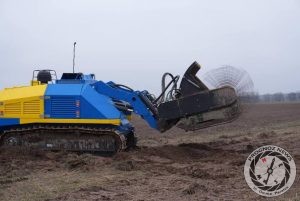
One of the most notable developments has been the emergence of unmanned ground vehicles specifically designed for de-mining. These robotic platforms can enter dangerous areas ahead of human operators and either detect or neutralise explosive hazards remotely. A leading example is the Ukrainian-developed Zmiy system. Equipped with specialised mine-clearing attachments, the robot can traverse contaminated terrain, triggering or destroying explosive devices while keeping personnel at a safe distance. Field testing and certification have demonstrated its ability to clear pathways through minefields before human teams move forward.
The significance of systems such as Zmiy extends beyond simple mechanisation. Earlier generations of mechanical mine-clearance equipment tended to be large, expensive and difficult to transport. Ukraine’s experience has favoured smaller, cheaper and more adaptable machines that can be rapidly deployed to remote locations. This mirrors a broader trend in Ukrainian defence technology, whereby affordability and scalability often take precedence over technological extravagance. The result is equipment that can be produced in substantial quantities despite wartime constraints.
More recent developments have pushed this concept even further. Ukrainian authorities have begun introducing lightweight robotic platforms capable not only of neutralising mines but also of carrying supplies and performing other battlefield functions. The NEO-1 system exemplifies this trend. Weighing only around sixty kilograms, it can be transported by ordinary vehicles, operated remotely and equipped with sensors that enable both mine-clearing and logistical missions. Such multi-role platforms are particularly attractive because they spread procurement costs across several military and humanitarian functions.
Yet ground robots represent only one component of Ukraine’s technological revolution in de-mining. Equally important has been the use of aerial systems. Unmanned aerial vehicles now perform reconnaissance missions over suspected minefields before any personnel enter the area. Equipped with high-resolution cameras, thermal sensors and increasingly sophisticated magnetic detection systems, drones can identify anomalies that suggest the presence of buried explosives. The Ministry of Defence has begun training specialists to employ drones in conjunction with advanced magnetometers capable of detecting changes in the Earth’s magnetic field associated with concealed metallic objects.
The integration of aerial reconnaissance with ground robotics creates a layered approach to mine action. Drones survey large areas quickly and identify potential hazards. Ground robots then investigate and neutralise threats. Human de-miners intervene only when necessary. This methodology significantly reduces risk while accelerating operations.
Artificial intelligence is increasingly becoming a central component of these efforts. The sheer quantity of imagery generated by drones presents a challenge for human analysts. Machine learning systems can help identify patterns associated with minefields, trench networks and unexploded ordnance. By processing vast amounts of visual and multispectral data, artificial intelligence can prioritise areas for further investigation and reduce the likelihood that dangerous objects will be overlooked. Research projects increasingly focus upon combining visible-spectrum imagery with infrared and multispectral sensors to improve detection rates under varying environmental conditions.
A particularly promising area involves the fusion of multiple sensing technologies. Traditional metal detectors struggle with plastic mines containing minimal metallic content. Modern approaches therefore combine optical imagery, thermal imaging, LiDAR mapping, magnetic sensing and chemical detection techniques. The objective is to create a comprehensive picture of the terrain rather than relying upon any single indicator. Ukraine’s mine action community has become one of the world’s most active testing grounds for these integrated systems.
Another remarkable feature of the Ukrainian experience is the speed with which battlefield lessons are transferred into civilian applications. Many of the unmanned ground vehicles originally designed for military logistics or reconnaissance have subsequently been adapted for humanitarian de-mining. Likewise, software developed to support military drone operations increasingly finds application in surveying contaminated civilian land. This cross-fertilisation between military necessity and humanitarian recovery has created a uniquely dynamic innovation environment.
International cooperation has further accelerated progress. Ukraine has received robotic de-mining systems from foreign partners while simultaneously contributing operational experience that influences the design of future platforms. Western manufacturers increasingly view Ukraine not merely as a recipient of technology but as an indispensable source of practical knowledge regarding robotic operations in highly contaminated environments. Ukrainian feedback has already shaped the development of several international unmanned ground vehicle programmes.
The economic implications are profound. Ukraine’s recovery depends heavily upon restoring agricultural production. Large portions of the country’s most fertile farmland remain inaccessible because of explosive contamination. Every technological improvement that increases the speed of clearance translates directly into economic output, export revenues and food security. The relationship between de-mining technology and national reconstruction is therefore immediate and tangible.
Nevertheless, significant challenges remain. No technology can entirely eliminate the complexity of mine clearance. Weather conditions, vegetation growth, varied soil compositions and the proliferation of improvised devices continue to create difficulties. Moreover, robotic systems require maintenance, operator training, secure communications and logistical support. Ukrainian commanders and operators increasingly emphasise that successful deployment depends not only upon the machines themselves but also upon the broader ecosystem that sustains them.
Yet despite these obstacles, Ukraine has established herself as one of the world’s foremost centres of innovation in unmanned de-mining. The same pressures that drove extraordinary advances in drone warfare have generated equally significant breakthroughs in humanitarian technology. Ground robots, aerial reconnaissance systems, artificial intelligence and multi-sensor detection platforms are increasingly working together to tackle one of the war’s most enduring legacies.
The consequences may extend far beyond Ukraine’s borders. Many countries emerging from conflict face similar challenges of explosive contamination. Technologies refined in the fields of Kharkiv, Kherson, Mykolaiv and Donetsk may eventually become standard tools for humanitarian de-mining operations throughout the world. Ukraine is not merely clearing her own land. She is helping to define the future of mine action itself.
The history of warfare is often a history of destruction. The history of de-mining is different. It is the history of reclaiming land, restoring communities and allowing life to return where death once lay hidden beneath the soil. Contemporary Ukrainian unmanned de-mining technology represents one of the most important chapters in that story.
114 Views



Most Readings