The Volunteer’s Victory
By Matthew Parish, Associate Editor
Monday 22 June 2026
There are moments in history when nations discover themselves. Not through declarations, constitutions or ceremonies, but through suffering. Ukraine’s modern identity has been forged in precisely such a furnace. Since February 2022, millions of Ukrainians have endured loss, displacement, fear and sacrifice. Yet amidst this crucible there has emerged something stronger than military resistance alone — a collective determination to remain free.
For those of us who arrived from elsewhere, the experience of participating in this struggle has been both humbling and transformative.
Foreigners are often assumed to stand outside the history of the countries in which they reside. We are guests, observers, commentators. We may sympathise, we may assist, but we remain somehow detached from the deeper currents of national experience. Ukraine has challenged that assumption. The war has created a community of purpose that transcends passports.
One does not need to have been born in Ukraine to understand why her freedom matters.
Indeed, for many foreigners who have chosen to make Ukraine their home, the war has become a profoundly personal experience. The distinction between “their war” and “our war” gradually dissolves. Friends are mobilised. Colleagues disappear to the front. Familiar streets acquire memorials. Cafés fill with soldiers on leave. Air-raid sirens become part of the rhythm of daily life.
The war ceases to be an event and becomes an environment.
And yet there is something remarkable about living within a society under such pressure. One discovers that courage is often much quieter than expected.
The world likes stories of heroes. It prefers dramatic narratives of battlefield exploits and extraordinary acts of bravery. Those stories certainly exist. Ukraine has produced countless examples of astonishing courage. But the deeper heroism lies elsewhere — in the teacher who continues teaching while missiles fall, in the engineer who works through blackouts, in the doctor who remains at a provincial hospital despite the risks, in the pensioner who donates a portion of a modest income to purchase drones for soldiers at the front.
Ukraine’s resilience is not built upon exceptional people.
It is built upon ordinary people doing exceptional things every day.
For a foreigner, witnessing this can be profoundly moving. One arrives expecting to help. Instead one often discovers that the people one intended to assist become one’s teachers.
Perhaps the greatest surprise for many foreigners has been the absence of hatred. There is anger, certainly. There is grief. There is exhaustion. There is determination. Yet one repeatedly encounters a refusal to surrender to bitterness.
Many Ukrainians distinguish carefully between the Kremlin and ordinary Russians. Others have lost the luxury of making such distinctions after years of violence. Both responses are understandable. But what remains striking is that the national conversation is overwhelmingly oriented towards the future rather than the past.
People speak about rebuilding cities that are still being bombed.
They discuss economic development while missiles remain a threat.
They plan businesses, schools, cultural institutions and infrastructure projects for a post-war future that has not yet arrived.
Such optimism is not naïve. It is an act of defiance.
To participate in this environment as a foreigner is to encounter a form of patriotism that differs markedly from many western conceptions of the term. In much of the contemporary West, patriotism is often viewed with suspicion. Historical memory has made many societies wary of national sentiment.
Ukraine reminds us that patriotism can also be profoundly liberal.
It can mean defending pluralism.
It can mean protecting democratic choice.
It can mean preserving the right of citizens to determine their own future.
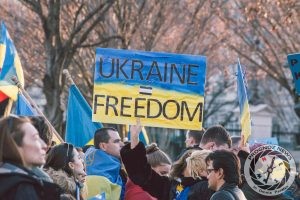
The Ukrainian flag has become a symbol not of conquest but of resistance to conquest.
That distinction matters enormously.
The gradual military reversal of Russian ambitions has reinforced this understanding. Few informed observers would claim that victory has been easy or inevitable. The war has lasted far longer than many anticipated. The cost has been staggering. Entire communities have been scarred. Families have been separated. Lives have been shattered.
Yet when one compares the strategic objectives announced by Moscow in the early stages of the invasion with the realities of today, the contrast is unmistakable.
Ukraine remains sovereign.
Her government remains independent.
Her armed forces remain intact.
Her society remains vibrant.
Her identity has become stronger rather than weaker.
The Russian leadership sought to extinguish Ukrainian nationhood. Instead it helped consolidate it.
Living through this process produces an unusual mixture of emotions. There is pride, certainly — pride in having contributed, however modestly, to a cause larger than oneself. There is admiration for the extraordinary endurance of Ukrainian society. There is gratitude for friendships forged under difficult circumstances.
But there is also caution.
Those who have spent significant time in Ukraine understand that triumphalism would be misplaced. The cemeteries continue to grow. Air-raid alerts continue to sound. Families continue to receive devastating news from the front. Freedom is advancing, but it has not yet fully prevailed.
The war remains unfinished.
Nevertheless, there are moments when one senses the direction of history.
A newly opened business in a city that was once under threat.
Children playing beneath a monument draped in national colours.
A train arriving precisely on schedule despite years of conflict.
A crowded restaurant filled with laughter on an evening when distant explosions can still be heard.
Such scenes may appear mundane. In reality they are manifestations of victory.
For authoritarian regimes often misunderstand the nature of freedom. They imagine freedom to be a political arrangement that can be destroyed through military force. They assume that if institutions collapse, freedom collapses with them.
Ukraine has demonstrated the opposite.
Freedom is ultimately a habit of mind.
It resides in relationships, communities and shared convictions.
It survives blackouts.
It survives bombardment.
It survives occupation.
And when enough people possess it, it becomes extraordinarily difficult to defeat.
For a foreigner who has become part of this movement — however small his role may be — there is a profound privilege in witnessing such a phenomenon firsthand. One realises that history is not merely something recorded in books. Occasionally it unfolds before our eyes.
One also realises that the struggle for Ukrainian freedom is not solely about Ukraine.
It concerns a broader question — whether nations possess the right to choose their own destinies, whether democratic societies can defend themselves against aggression and whether human beings can preserve their dignity when confronted by overwhelming force.
Ukraine’s answer has been clear.
Not through speeches but through sacrifice.
Not through slogans but through endurance.
And for those foreigners fortunate enough to stand alongside Ukraine during this extraordinary chapter of history, the experience leaves an indelible impression — the rare privilege of participating, however modestly, in the defence of freedom itself.
106 Views


Most Readings